
This article by Billy Cooney originally appeared on his Substack flâneurbanist and is republished here with permission.
Intro
Since I began studying cities I’ve seen zoning transform from an obscure policy into a common topic in public discourse. Locals across the country are organizing to change zoning laws and outlets such as The New York Times are making zoning and NIMBY commonplace terms. This is great news for any urbanist or policy wonk familiar with the shady history of zoning—exclusion and segregation—and its stranglehold on cities’ ability to build more housing.
Zoning does not particularly lend itself to public interest. It’s full of legalese, complicated appendices, and extraordinarily detailed tables full of planning nomenclature. Even as someone who has studied urban planning, I find myself frustrated by how difficult it is to figure out something as simple as where an Accessory Dwelling Unit can be built.
It’s exciting that an obscure yet important policy item has become a hot topic. Strange, then, that I would find myself cautioning against treating zoning as a panacea. I don’t wish to take away from its importance. Frankly, I think the restrictive nature of zoning in the US comes with a lot of ill side effects: some we can see, such as an affordable housing crisis, and some we can’t, such as the neighborhood cafe that never opened up down the street. I believe making zoning more inclusive would yield many benefits for most neighborhoods. However, while zoning holds the key to making our cities more livable, I don’t think it’s a fast track to the romantic vision some are offering.
Zoning Isn’t a Panacea
Take an extreme example, from Hayden Clark,1 where urban design is assumed to beget a politically ideal world free of friction:
I agree these places are beautiful and that beauty alone reflects a society’s commitment to public health and social well-being. But I’m not under the impression that good urban design begets respect, politeness, or political harmony. There are many beautiful places in the world ravished by social and political instability.
On the other hand, design can intentionally be hostile to public health and social well-being. There is the oft-shared meme dissing boomers about the “outside” they have made. It presents an obvious critique of the auto-oriented suburban landscapes that dominate American metros.
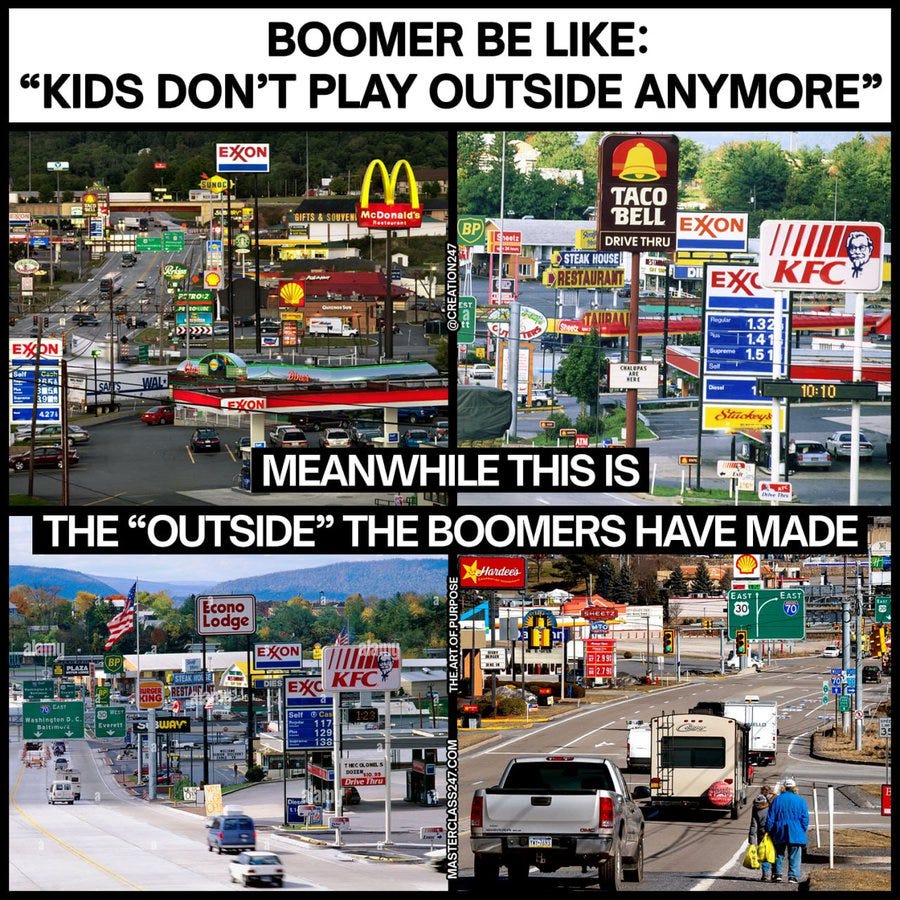
These places are dangerous and uncomfortable for anyone outside a car—especially children learning to navigate streets and traffic. And it’s true that the degradation of the public realm, caused by both zoning and transportation policy, makes vibrant public life impossible in those places. Zoning is truly a huge barrier, but on the other side of zoning is not a time machine.
While zoning doesn’t allow the types of development depicted in Hayden Clark’s post—places we need more of—it’s wrong to assume that its removal would lead to a development pattern from hundreds of years ago.
Take Patrick Risk’s post on LinkedIn, contrasting block-size apartment complex in the US with historic developments in Amsterdam:
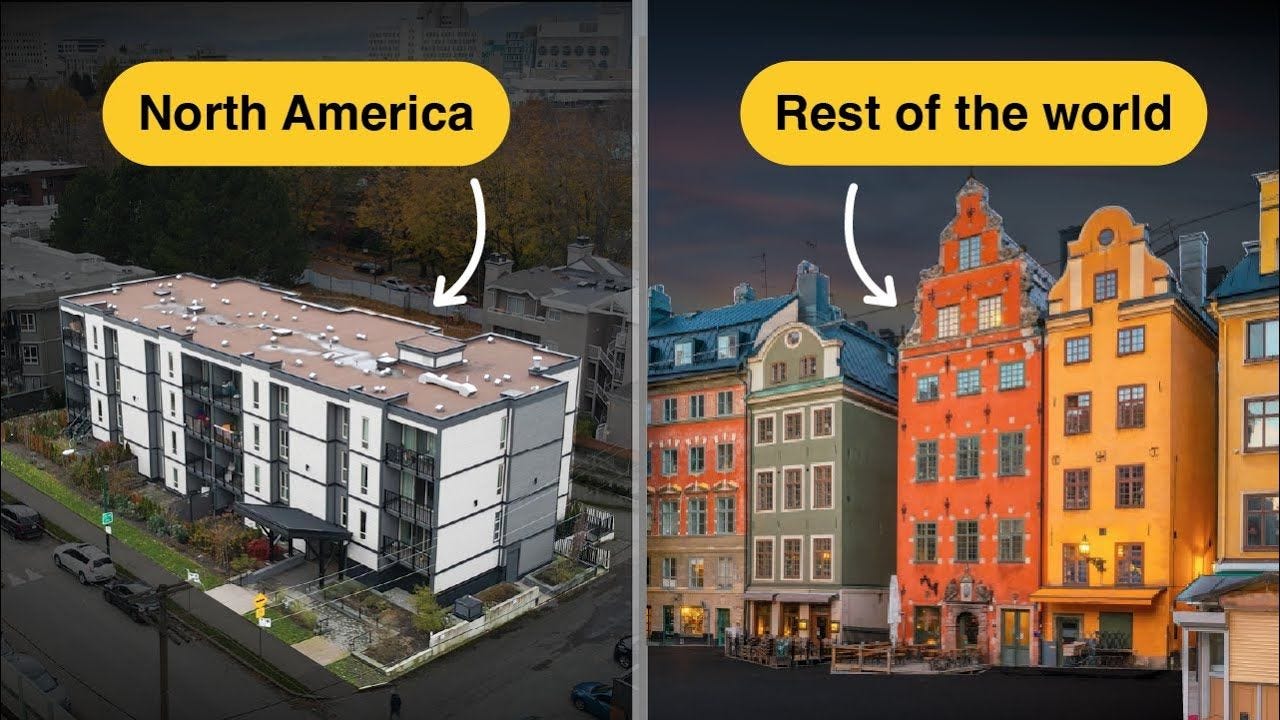
Patrick says “you get what you ZONE or regulate for.” But even in cities like Amsterdam, known for their historic charm, new development is trending toward larger, more conventional apartment blocks—albeit better designed than ones in the U.S.
In my brief time there, I noticed mostly larger scale apartment complexes going up, not too unlike the North American example above. They just happen to be better designed and typically aren’t built inside a moat of parking or wrapped around a humongous parking garage.
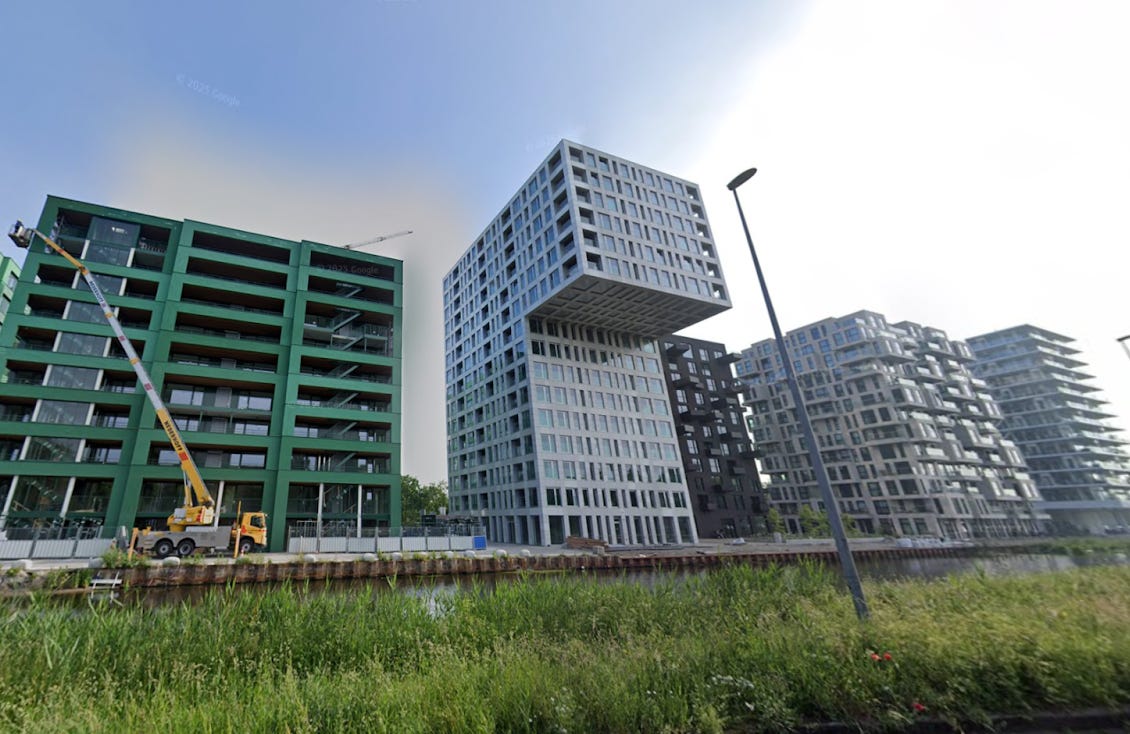
Good urban design isn’t just curtailed by zoning; it’s curtailed by economics. And this factor is affecting urban development across the world.
Jon Birdsong broke down the role of economics when writing about his company’s historic rehabilitation in Downtown Atlanta:
If everything goes exceptionally well and our team flawlesslessly delivers a building that was Atlanta’s first department store, built 125 years ago that hasn’t been occupied in over 30 years while also finding 34 people in 26 units who want to co-pioneer a neighborhood next to Kessler Loft residents, and we convince three retail tenants to believe early before the building is finished to sign on the dotted line, SoDo Atlanta, LLC plans to make 4.82% on the invested dollars. That barely eeks out the current 3 month T-bill or a high-yield savings account.
Getting rid of zoning would not unleash urbanism of times past if the math doesn’t make sense.
Innovative, incremental infill development seems to be coming solely from people like Jon Birdsong willing to sacrifice profit—and there’s not many of them. As Chuck Marohn said in a recent podcast, “the people that do that work today are almost heroes because it is such an uphill battle.”
But even without the political and financial obstacles, urban design alone will not guarantee a thriving social life. That’s because the obstacles to community aren’t just physical. They’re digital, cultural, and deeply embedded in how we spend our time. If zoning divides us through space, technology now divides us through attention. And unlike zoning, it’s everywhere.
Silicon Enters the Equation
Robert Putman put technology on blast in his famous study on declining social capital in Bowling Alone. Noah Smith summarizes Putnam’s key point and adds what we know about smartphones and social media in a recent essay:
American society became somewhat disconnected by the introduction of the 20th century technologies of the car, the telephone, the TV, and the internet, but it managed to partially resist and preserve some remnant of rootedness. But phone-enabled social media broke through those last walls of resistance and turned us into free particles floating in a disembodied space of memes and identities and distractions.
The “rootedness, family, community, and faith,” that buttressed our social capital, Smith says, “turned out to be weaker than the new gods made of silicon.”
The kind of in-person socializing we used to do was a requirement—we had no other options. Technology has undercut our in-person socializing and social media has only made it worse. Social media is illusive in its accessibility and ease of use but insidious in its consequences. We socialize in person less and our communication habits no longer aid or abet community.
Absent the requirement of in-person socializing is also any communal rituals that bring people together. Consider Sam S.’s reflection on her time in Spain, where their culturally strict mealtime schedule frustrated her until its utility was made clear: Spain’s culturally strict mealtime schedule, acutely observed by Sam S. in Stories from Sevilla:
Eating is about taking a communal moment to gather together. And I believe that’s why there’s such a reliable, strict schedule. The driving force behind it is the intrinsic prioritization of making time to connect.
I can’t think of any US equivalent of this type of ritual togetherness. The default here is a sad desk salad or a depression sandwich.
Without shared rituals, we also lose the social context that animates our third places—the bars, cafes, and bookstores where community spills over from the home or workplace. I hear people decrying the loss of third places in terms of the physical spaces disappearing, as if we could build our way into a more connected society. Third places exist because of the culture people build in them. It’s not the bar that is special. It’s the people who go there day in and day out. They return not for the aesthetic but for the social atmosphere. Spaces don’t magically give way to community. The community co-opts those spaces—often private, capitalist spaces—into spaces where locals can hang out and connect.
It’s not that we don’t have enough space for third places but that the type of social capital that creates third places out of existing spaces is dwindling. There is nothing inherently social about any given coffee shop or bar; it’s the history and community that make the space meaningful. And as the connections within our communities fade, or get replaced by online spaces, so do those third places. After all, Putnam didn’t just call for changes to the physical environment, he called for more participation in all spheres of life: in religious, cultural, and political settings.
If we are “free particles floating in a disembodied space” as Smith says, maybe it’s less an issue of space and more a need for the connections that pull us there.
Public Space Matters—But How Much?
A quick look at the High Line in New York City or the Beltline in Atlanta shows how new, well-designed public spaces are quickly filled with people. When new spaces like this are created, they reveal a strong latent demand for quality public space. These types of amenities are things that people yearn for whether they realize it or not. And research supports that well-designed public spaces matter. The Bentway, Toronto’s contribution to the trend of turning underused right of way into public space, has been shown to have a positive impact on mental health. Similar research shows the positive effects of green space on loneliness.
Designing public space to be more social doesn’t require huge infrastructure projects, either. Even subtle design elements along streets and building facades can lend themselves to occupation and socializing. William Whyte’s famous study, The Social Life of Small Urban Spaces, shows how small things like entryway stairs, fountains, and columns create sticking points for people to linger and connect with others.
But new research shows something troubling: compared to the people Whyte studied from 1979 to 1980, people from 2008 to 2010 were seen to be “walking faster and doing less socializing.” If we no longer see public spaces as social spaces, how will providing physical sticking points and social opportunities help us? I worry we are beyond the point where street chats with a neighbor or the bodega cashier will save us from our trend towards isolation.
Assuming we can bring about radical change to suburban landscapes in the US to make them more conducive to social behavior, it won’t revive the type of social capital we had before television. Dense, walkable cities all over the world are dealing with loneliness epidemics. The UK, full of walkable villages designed before the advent of the car, created its first minister for loneliness in 2018. Japan, prized by urbanists for its well designed cities, also has its own loneliness minister. Even Switzerland has discussed creating one.
The Loneliness Lab, committed to making cities less lonely, argues that we need what they call hardware and software—in other words, good urban design and appropriate programming. I would go a step further and say we need a culture that values and prioritizes public life—one that is literally able to see public space as social space, not just space to move through, as those researchers have found.
Some researchers suggest we alter public spaces to make affordances for public solitude:
Little visibility of aloneness can signal that feeling lonely or wanting to be alone are uncommon or unaccepted, which can increase loneliness. The design of (semi-)public space should hence invite people to come alone. For instance, furniture in (semi-)public space that is intended or suited for individuals may visually normalise being alone.
Do these observations signal the decline of public space as social space? The beginning of a world where online space takes precedence over physical space?
The Disappearance of Rituals
In his book, The Disappearance of Rituals, Byung-Chul Han critically examines the rise of online social connections. Rather than developing relationships, he argues that digital space creates “communication without community,” where users are either curating themselves or consuming personalized content. Han’s philosophy is supported by research: “young people today are socially connected or hyperconnected but may still struggle to build deeper emotional bonds.” In his book, Han explores how this hyperconnectivity creates an “erosion of community” and a rising “collective narcissism.”
As Jonathan Haidt and his research team have documented, social media is not only addictive but harmful for mental health, especially for teens and young girls. And these effects are international, even in cities with quality public space. Heavy users of social media platforms across the world are showing worrisome declines in mental health, especially in individualistic nations, where “smartphones and social media are more likely to be used for self-focused motivations, such as promoting oneself and distinguishing oneself from others, with large quantities of shallower connections.”
Han explores how our narcissistic obsession with ourselves bleeds into the real world, creating a cult of authenticity that prevents the kind of communal rituals that provide social bonding:
The culture of authenticity goes hand in hand with the distrust of ritualized forms of interaction. Only spontaneous emotion, that is, a subjective state, is authentic. Behavior that has been formed in some way is denigrated as inauthentic or superficial (p. 23).
Something as simple as being polite by talking about the weather becomes uncomfortable since it is seen as “inauthentic or superficial.” But “politeness is an as-if ritual,” Han says; social rituals are chances for us to “imitate happiness” (p. 22). We don’t perform rituals in order to express something arising from within us but to affirm something external that unites us. Even when we’re not feeling happy, research shows that the simple act of smiling makes us feel better, even if we don’t feel like it. Likewise, social rituals provide ways for us to connect socially, even when we feel isolated. The cult of authenticity, however, threatens to further degrade that practice.
Han goes on to argue that the increasing narcissism of our digital world is leading to a crisis of community. Instead of providing opportunities to find resonance with values or causes larger than ourselves, we are presented with “echo chambers in which the voices we hear are mainly our own” (p. 11).
Acquiring information wasn’t always a solitary activity. It used to require a ritual of greeting, talking, inquiring, and discussing. People would hang out in front of the general store or saloon. Getting information was part of the act of socializing and affirming we are all here together. Now, that ritual is gone. People who think differently are not in front of us but out there. Our identities are more concerned with our uniqueness as individuals and less with the communities we belong to and the bonds that hold us together.
With meaning coming more and more from the individual and less and less from community and society, rituals lose their imperative as affirmations of belonging and meaning. As social rituals erode, so does the utility of public space replaced by digital streams of information and performative authenticity.
These conditions feed into neoliberal politics as well. Han argues that in the neoliberal regime, “ideas of freedom and self-realization are transformed into vehicles for more efficient exploitation” (p. 18). The notion of authenticity convinces you to “exploit yourself voluntarily in the belief that you are realizing yourself.” Even the act of rest comes to be valued only to the extent that it provides “a form of recovery from work” or serves our increasing obsession with optimization.
The Politics of Togetherness
While Han sees increasing social media use as inherently political, Vicente Navarro argues that social capital is political as well. Rather than being an abstract good, social capital is both dependent on and affected by politics. In an address to the Annual Congress of the Eastern Association of Social Sciences, Navarro criticizes Putnam for framing social capital as apolitical.
The term “capital” itself assumes that the benefits of social bonds will be used to further one’s own ends in a competitive market. It frames the benefits of social bonds as a type of currency, yet the real benefits of what Putnam calls togetherness—stronger communities, healthy norms, and social trust—is fundamentally at odds with that.
Putnam praised the Progressive Era for its civic inventiveness but attributes its success to political leaders. Navarro argues that this success wasn’t the result of wise and benevolent leaders but rather the grassroots organizing of labor movements. People did not mobilize to explicitly build stronger social capital; rather, they accumulated social capital as a by-product of mission-driven organizing. Social capital isn’t just something we accumulate, he argues; it’s something we build, often through collective struggle.
Reinvigorating social capital isn’t quite as spending more time volunteering. It requires building a society in which everyone is afforded the time and resources to build community. This requires not only creating a social safety net but a culture in which public health and general well-being are valued. A culture that waives those beliefs in favor of corporate power, radical wealth inequality, and a prioritization of the individual above community will fail to provide the social benefits of Putnam’s prized togetherness.
Community As Practice
In many ways urban planning’s goal is to create a more ideal world. At the heart of urban planning advocacy are people fighting for transportation equity, sustainability, and affordable shelter. People wait for hours to speak at city council meetings because they genuinely care about the communities they are building—not just about their lives but the lives of their neighbors. This commitment to communal well-being is arguably the most important part in the fight for better policy.
Better zoning policy and good urban design don’t beget social capital—not alone, and not in an environment where our social connections are frayed by harmful technology and revanchist politics. But fighting for a better world, for cities that nurture social and mental well-being, is worth it—especially when we consider the value of organizing in itself.
The fight for more socially vibrant cities won’t end with a zoning rewrite. At the end of the day, that’s not all we are fighting for. We are fighting for a culture that prioritizes equity, accessibility, safety, and even beauty.
Zoning may structure our cities, but culture, ritual, and organizing fill it with meaning. Community won’t be restored by policy change alone. But by choosing to fight for better policy we can practice the rituals that build community and reaffirm that the commons matters—that despite our individualism and algorithmically-induced isolation, we still recognize that community is a practice.
I should say here that I enjoy Hayden Clark, perhaps more well known as The Transit Guy, and his takes on the absurd realities of car-oriented planning in the US. He does a great job comparing the US to international examples that showcase how possible it us for us to build better transit and urbanism.
Thumbnail art: “The Idols.” 1949. Cady Wells. Art Institute of Chicago, Gift of Mason Wells.
Thank you for this thoughtful essay. I would just note, that, as you say about organizing in general, organizing for zoning reform can itself help create community. At least that's what's happened here in my neighborhood of Boston. It's brought a lot of people together to make housing easier to build, and in the meantime we have created really strong ties with each other. And folks really LOVE meeting in person. We've also started a book group, coffee hours, and happy hours. In the end, the ties that we've created with each other and with the community, may be what's most long lasting.
The purpose of a system is what it does.
Economics and land use regulations are intertwined. In urbanism topics, "There's no market for _____" is typically because _____ is downstream of a rigged market (i.e. zoning & co).