

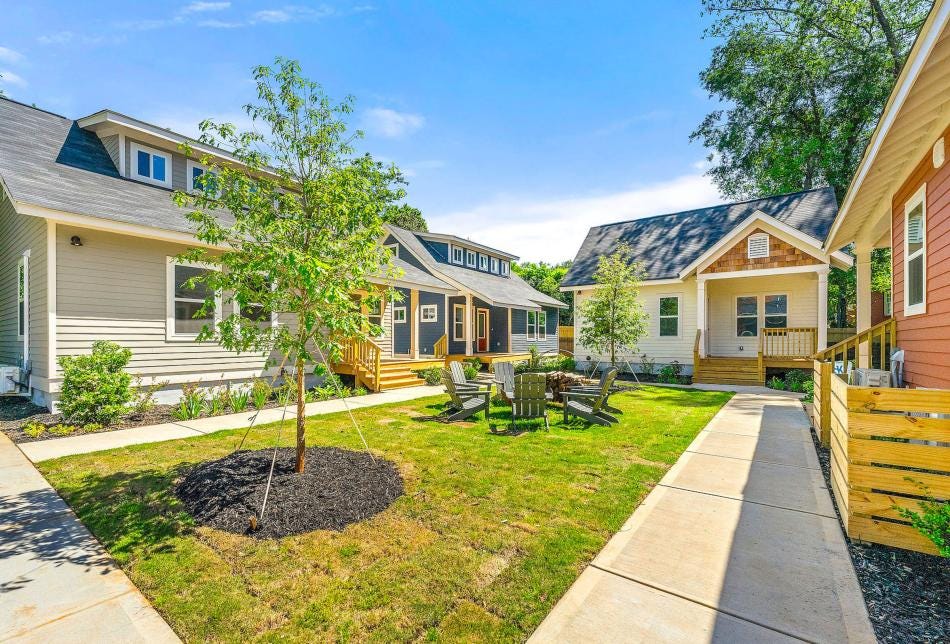
This is Part II of a series on how the Homelessness & Incremental Housing Toolkit put together by Kronberg Urbanists and Architects could be used for faith-based housing.
Part I explored floor plans that are ideal for a faith-based housing development.
As I’ve learned my way around the infill development world, I’ve been consistently shocked by how much housing can fit onto relatively small lots.
I regularly look at sites and assume that they can only fit one or two homes—maybe a duplex, or maybe a single family home and a backyard cottage. My boss usually politely chuckles and tells me he could fit 4, maybe 5 small houses while quickly sketching out a site plan that makes the most of every inch of the lot.
You might assume that squeezing small units onto small lots might end up feeling claustrophobic, but a few simple design principles can actually lead to housing that is welcoming, comforting, and feels spacious. Best of all, a smaller house is more affordable, and land costs are spread amongst more units, creating greater affordability without subsidy.
Last month, I wrote about some house plans that work well for faith-based housing. All relatively compact studio, 1, and 2 bedrooms that can house a variety of demographics on a range of sites.
Yet arranging those unit types efficiently to make the most out of a limited amount of land is an absolute must, especially for congregations with oddly-shaped lots and a need for a well-designed space that will last.
But how do you make the most out of your land?
I’ve selected a few examples from the Homelessness & Incremental Housing Toolkit to illustrate.
Single Lot Site Study
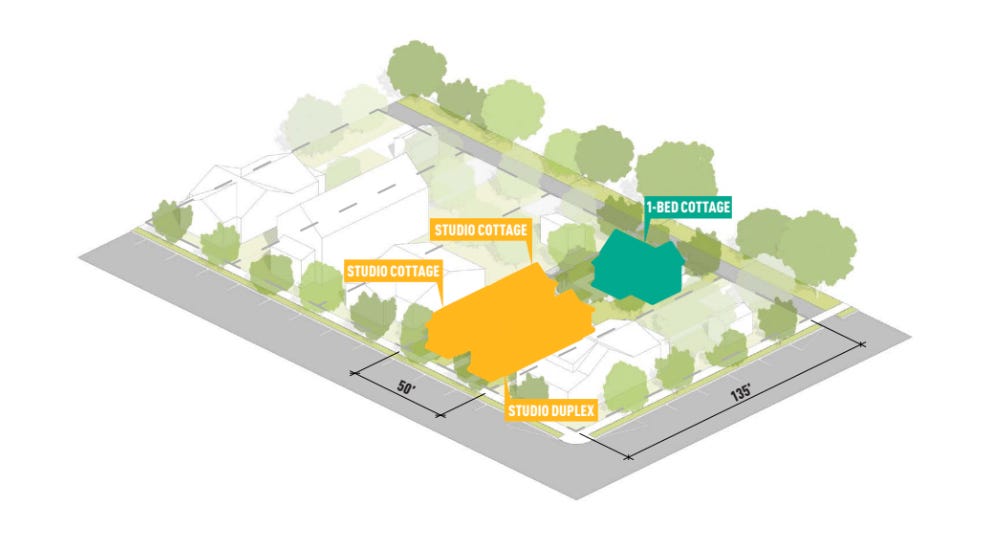
This single lot has a surprising amount to offer. Here, Kronberg Urbanists and Architects managed to fit 5 units of housing onto this 50’ by 135’ lot. That’s not very big—it’s only .15 acres.
Most houses of worship have more property than this, but much of it can be taken up by the sanctuary, parking, or other existing buildings. These five units, though, could still fit onto the side or back of a lot on an unused field or excess parking.
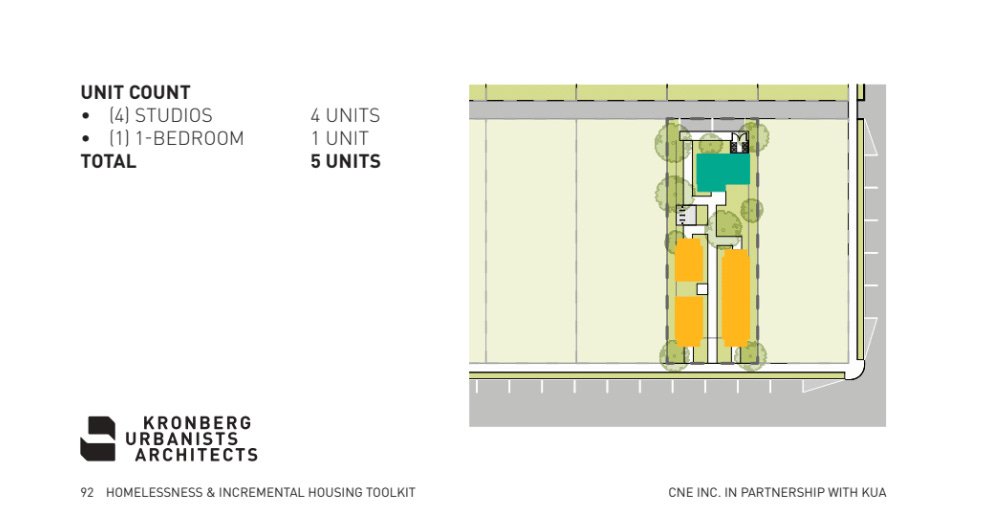
Though the amount of green space on this site might not be ideal, it really is a tiny piece of land. When fit onto a larger site, it is possible that more common space could be created.
Even a little more land offers a great deal more flexibility with open space, as shown by the next site.
Double Lot Site Study
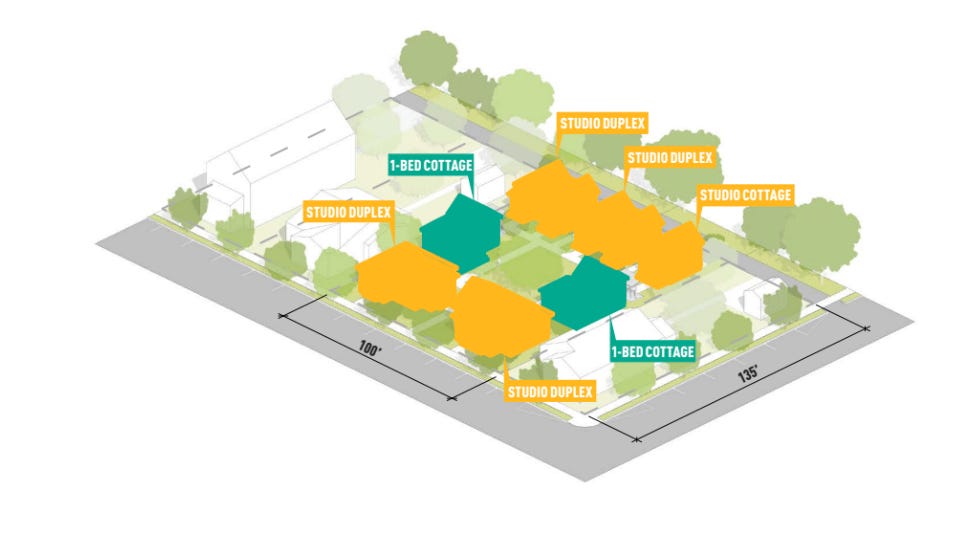
Doubling the lot opens up a lot more opportunity. There’s now a central green space in the middle of the site which acts as a common area while also opening up the site and making it feel roomier.
Though the units in this example are still relatively small, the bigger lot would afford greater flexibility to include larger houses like the 1 and 2 bedrooms I talked about last week.
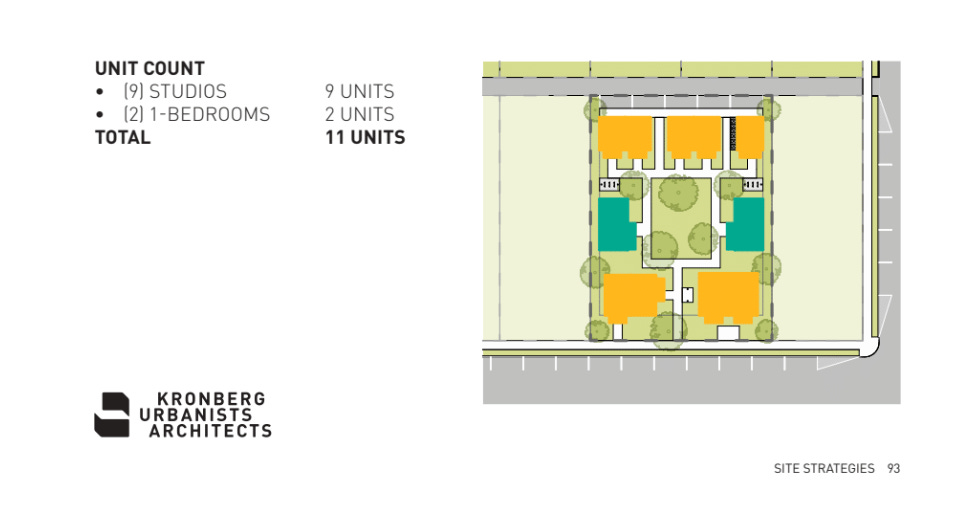
This lot is still pretty small, only .31 acres, and yet it can fit 11 units. The added width really opens it up a lot—especially with a larger passageway between the two street-facing houses that beckons you into the central courtyard.
How Does this Work on Faith-Owned Land?
Houses of worship have special considerations when building housing on their land. The examples above were designed as an affordable infill housing solution for those experiencing homelessness. A congregation’s mission might align with those priorities, but they could also desire a more permanent population such as older folks or families.
All these needs are valid and must be designed for.
Some of these changes would be simple, like making the duplexes into larger houses appropriate for families. If the church has more land, it might want to spread the houses out a bit more to create more courtyard space, or integrate the houses differently with existing buildings.
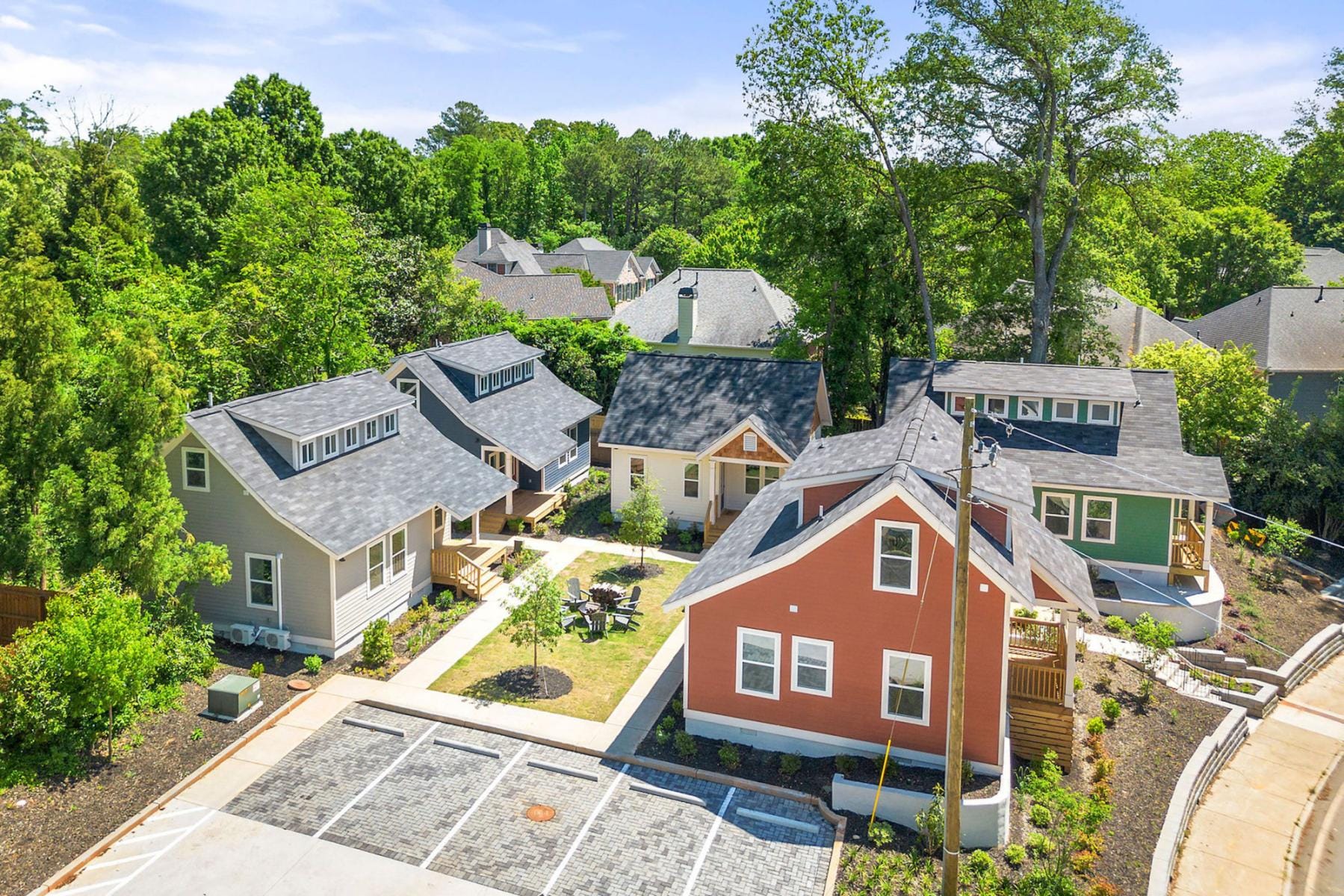
The most important element is beauty.
Congregations that strive to build housing on their land should aim to create beautiful places designed to last. This is not only important for the church—it makes their place more inspiring and meaningful—but also to the residents who will feel at home and have a reason to care about where they live.
Designing for beauty isn’t difficult—sometimes it’s as simple as planting two trees. Imagine what the cottage court above will look like once those two trees in the middle mature and offer shade to residents relaxing below.
All of this, and more, is possible on faith-owned land. It doesn’t take a huge tract of unused land to create something beautiful, nor does it require reworking your entire site.
It just requires a little bit of creativity, and recognition that you might have more land than you think.
Eli Smith is the Director of Southern Urbanism’s Faith-Based Housing Initiative. He is a recent graduate of Dartmouth College, where he studied Religion with a focus on the faith-based housing movement.