


A soul so old, in a twenty first century rig
Working without knowing why
Maybe it’s better to forget
Tune out for a little while
Just to see it from afar
Tune out like riding forever
Forgetting who is driving the car
Forgetting who is even in charge
–“Tune Out,” The Growlers
Intro
I read an article by Paul Jones III recently that got me gnawing at a particular issue. It’s an article that touches on many things: the decline of the planning profession’s efficacy and influence, an argument for the importance of intentional city planning, and a call for the planning profession to step up. It begins with a powerful question: where are the planners?
This question points to a feeling that planners are missing not just physically in “neighborhood efforts, discussions, block clubs and other grassroots initiatives,” but politically in their influence on the development of cities. On the one hand, planners are absent from opportunities to learn from communities, to build relationships, and to educate the public on important planning efforts. On the other hand, the policies and programs they do advance come not from deep knowledge of communities but from behind a desk.
Jacobsian Turn
These two observations identify both the challenge and the solution to the planning profession’s dilemma. Planners have retreated from the forefront of politics and public discourse. To make the profession more visible and influential, planners need to build credibility through community engagement and political advocacy.
We can credit the profession’s retreat largely to the public interest movement of the 1960s and, in urban planning, Jane Jacobs specifically. Thomas Campanella charts this history in a wonderful essay in Places journal where he explains the legacy of the “Jacobsian turn” in planning.
Campanella lays out the legacy in a few related points: One, planners lost their identity centered around “strong, centralized physical planning.” Urban renewal was bad and the profession rightly stepped back from drastically reshaping communities, but projects like the Atlanta Beltline illustrate the power of investment in physical planning. Two, the profession has replaced its professional expertise with public input. “Imagine,” he says, “economists at the Federal Reserve holding community meetings to decide the direction of fiscal policy.” Instead of leading public opinion, planners are led by it. Third, planners have subsequently lost their visionary capacity.
To illustrate this legacy, Campanella shares a story about how a group of residents catalyzed a revival of a rail station in Hillsborough, NC with Amtrak service (now coming in 2027). They started with a petition which students drafted into a proposal. Coverage by the local paper inspired the city to purchase the station and make a task force. Seeing this momentum, Amtrak and the North Carolina Railroad Company became interested and before you know it there was an actual plan in place. It’s a story worth celebrating, and Campanella does. But, “all along I kept wondering,” he says, “Why did this have to come out of a coffee shop and a classroom? Where were the planners?”
In the absence of public leadership from planners, other people have to step up. In Campanella’s case, it was local urbanists who loved getting together to drink coffee and talk about ways to improve their community. In Asheville, it’s not much different. The city recently saw a suite of zoning reforms proposed not by the planning department but by a volunteer planning and zoning commission with the support of the local Strong Towns and YIMBY Action chapters.
When I solicit explanations from people more sympathetic to our planning department I often hear them say, well, the department is too busy. We do have bold ideas, they say, but we’re swamped. Campanella hears the same excuses:
Too busy planning. Too busy slogging through the bureaucratic maze, issuing permits and enforcing zoning codes, hosting community get-togethers, making sure developers get their submittals in on time and pay their fees. This is what passes for planning today. We have become a caretaker profession—reactive rather than proactive, corrective instead of preemptive, rule bound and hamstrung and anything but visionary.
Relinquishing Power
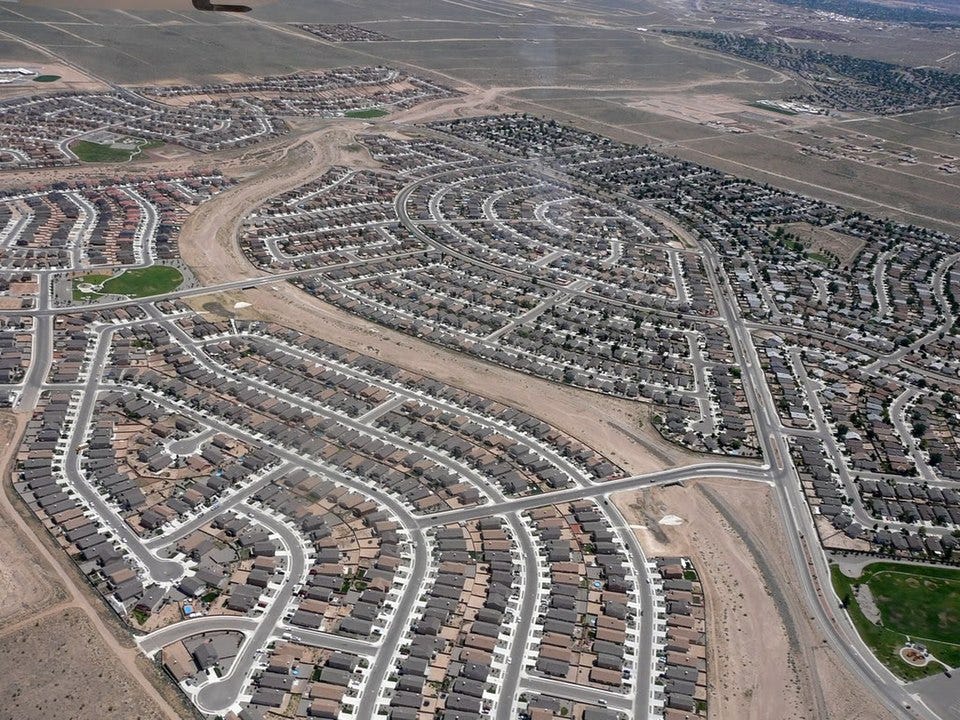
What happens when planners are too busy to lead? It feels like we have no one guiding our cities. In place of a strong, central planning department we have a motley crew of actors with incoherent agendas that collectively drive our cities towards poor ends. Engineers stretch our streets, leaving little room for bike lanes or sidewalks or any sort of public realm. A loud minority of residents fight change, even when it comes in the form of undisputed goods like affordable housing or bike lanes. Fire marshals refuse to compromise on street design despite the fact that millions of people around the world live in communities that violate their standards. And developers plan subdivisions for privacy at the expense of connectivity and an effective transportation network.
Sure, planners might redo the comprehensive plan every few years but it means little when sprawl continues unabated, when the priciest neighborhoods are still frozen by zoning, when the most vulnerable neighborhoods are still unprotected from displacement, and when road deaths continue to rise.
The irony of the Jacobsian turn is that we took away all of planners’ power yet reformed none of our car bias. We stopped bulldozing neighborhoods for highways and towers in the park. But the ideology and regulations that accompanied this—single family zoning, parking minimums, level of service metrics that encourage car-oriented design, and so on—remained untouched. To combat the overreach of urban renewal, we made everything more bureaucratic and difficult to change yet left behind the legacy that has made cities dangerous, polluted, and fiscally broken.
So after planners traded directing for facilitating, they left in power an anti-city ideology. The auto industry’s campaign against pedestrians taught Americans to believe cars deserved ultimate priority on the road. Their ads promoting cars as fun, adventurous toys taught Americans to argue for cars as tools for freedom. Despite the fact that the cost of car dominance is 40,000 deaths per year and an average financial burden of $1,025 per month per car—an extra rent payment in most places—planners have largely aided and abetted these arguments as long as they came under the guise of community input.
Jeff Speck has most succinctly criticized the planning profession in his “Planners Pledge,” a recommended code of conduct that goes above and beyond that of the American Planning Association (APA). “We must step forward,” the pledge declares, “with a new model of professional conduct designed to undo nearly a century of misdirection.” The pledge is full of explicit strategies that APA supports in certain contexts but not absolutely. For instance, APA advocates for “right-sizing” minimum parking requirements, not eliminating them entirely.
The spirit of the Planners Pledge is that planners can no longer afford to equivocate on issues that are vital to undoing mistakes that have “worsened public health, lost economic resiliency, exacerbated inequity, and undermined the social fabric of our communities as our daily driving cooks the planet.” The timidity in which planners equivocate on something as unnecessary as parking minimums—developers will build the parking anyway—does not match the severity of the consequences of the world we’ve helped build.
Most importantly, the pledge says, “When a majority of planners have the knowledge and the courage to get these things right, the profession will achieve the positive outcomes it needs to regain the public trust and enter a new era of civic leadership.”
What our cities are in need of, and what many hope the planning profession can provide, is a coherent vision for building a better future: a future where tens of thousands of lives aren’t lost for no good reason, where physical exercise isn’t most convenient at the end of a car trip, where the average worker can afford paying rent, and where the communities we build are strong enough to last for hundreds of years.
We Know What to Do
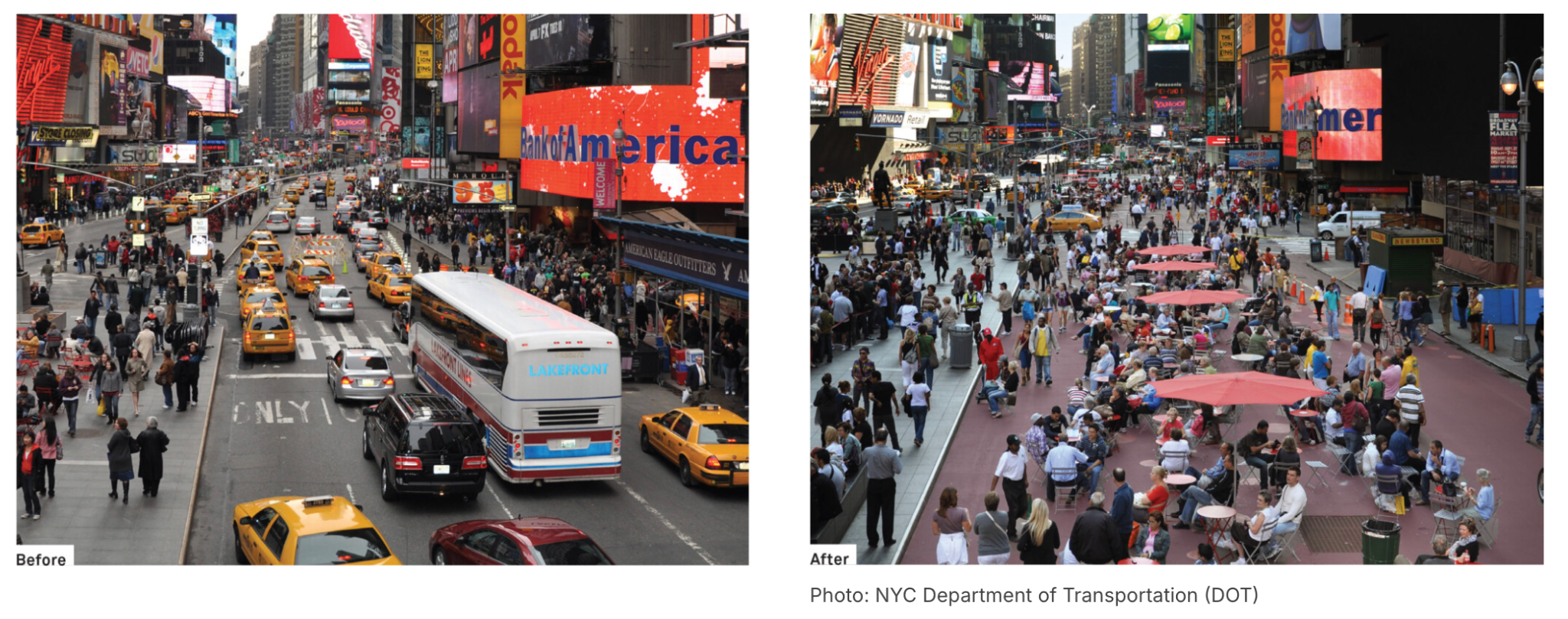
It’s not that planners don’t know what to do: we have the entire world to pull examples from. Singapore used state capacity to build affordable housing. Portland designed their zoning code to accommodate gentle density and affordable missing middle housing. New York City reclaimed Times Square for public space with great success. Paris dramatically increased the share of people who cycle by building top tier bicycle infrastructure.1
Yet when proposals of this caliber come up for discussion, most places claim they won’t work there, that somehow they are uniquely incapable of changing. Often frozen by a we’ve-never-done-that-before attitude, we’re somehow unaware that the placeless sprawl we’ve smeared across much of America is in itself a one-of-a-kind feat. If we can obliterate a millennia of traditional urban planning in less than a century, mostly for the benefit of a singular mode of transportation, we can certainly figure out how to build cities for health, wealth, and beauty.
In fact, some of the most bold planning initiatives we celebrate today had never been done before:
Barcelona’s superblocks transformed neighborhood streets into safe gathering places for residents
New York City’s High Line turned a derelict rail line into a vibrant urban park
San Francisco’s Embarcadero Freeway freeway removal replaced a double-decker highway with a public waterfront
The Kalamazoo Mall in Michigan popularized pedestrian streets
Portland’s urban growth boundary made intentional urban growth a requirement
Massachusetts’ Comprehensive Permit Act, dubbed the Anti-Snob Zoning Act, encouraged more affordable housing development
Paris’s 15 minute city goal lead them to build around 40 miles of bike lanes every year for the past decade
Medellín’s gondola linked the city’s poorest neighborhood with downtown
Bogotá’s Ciclovía temporarily reimagined miles of streets as public space and sparked an international phenomenon
What happens when cities aren’t bold? We lose out on opportunities to transform our communities for the better. But more importantly, we let important decisions go to parties with entrenched power: NIMBYs that don’t want their neighborhoods to change, asphalt companies that want to pave more highways, or developers who want to ravage the countryside.2
Show not tell
It would be a mistake to argue that planners should just ignore the naysayers. I don’t believe planners should be retreating from community engagement. In fact, I think they need to be doing more of it. The decline of political courage and intellectual influence that the profession has experienced for decades will not be reversed by strong-arming communities but by building coalitional support for two things. One, the belief that urban design and planning are integral to achieving better outcomes for public health, community vitality, equity, economy, fiscal resilience, and environmental sustainability. And two, that building a better world is possible—even though it may be difficult.
Planners need to show people what a better world can look like. We need to redefine engagement as not just listening but doing together. Planners need to show, not tell, and they don’t need to bulldoze neighborhoods to do it. They can temporarily close streets to illustrate just how much more valuable a space can be when it’s filled with people. They can activate slivers of street space with cheap, quick-build techniques like New York City is doing with its plaza program. They can host design competitions to reimagine publicly owned land and inspire hope for development. They can empower residents to improve their communities themselves by offering street painting permits or hosting block parties at no cost like Portland does, or using participatory budgeting to let residents decide how to spend money in their communities. This kind of engagement signals that planners are capable of working with the community to test and refine new ideas.
By visibly working to enhance the built environment and prove that their ideas have potential, while also owning failures, planners can position themselves as credible and trustworthy stewards for a city’s future.
Barkha Patel has been a tactical urbanism hero. Presiding over Jersey City’s public realm as Director of Infrastructure, Patel was able to achieve major improvements in safety and multi-modal transportation through innovative and iterative design projects. “Key to Patel’s approach was ‘tactical urbanism,’” Streetsblog USA says, “a practice of quickly deploying low-cost protected bike lanes or corner curb extensions, before building them out with hard barriers and planters.” The results speak for themselves:
Cycling in Jersey City tripled as a commuting mode between 2019 and 2024, according to a recent update to the city’s transportation master plan, as the protected bike lane network grew from zero to 25 miles under Patel’s watch. Today, one-eighth of the city’s streets have a protected bike lane.
We can have both a bold and experimental approach. Bold does not mean bulldozing communities to redesign a city. It doesn’t mean remaking cities from scratch. It does mean taking your ideas seriously, committing to your values, and following through. What Patel’s success proves is that incremental does not mean marginal. What an incremental approach can do is replace the convoluted and time-consuming process of surveys, analysis, and projections with a test we can see and feel. It takes the default, multi-year timeline that we’ve come to expect from planning projects and fast tracks it using an approach that is driven by action over process. By being incremental, planners can show communities what’s possible, not just tell them.
As much as we need planners to show us what they’re capable of, we need them to lead the conversation, too.
Public Educators
Communicating how and why urban planning is integral to building strong communities is perhaps one of planning’s most important responsibilities, but it is not always advertised as such. In the article that inspired this essay, Jones III said:
Planners largely shy away from the truly political nature of our work in order to avoid the hyper partisanship, violence, and negativity that have come to characterize that arena. It’s easy to understand why planners have been trained to take that approach. Many of us hope to fly below the radar and do good work, but I believe the disconnect it creates has harmed our field’s ability to create real impact and change.
I think it’s less that planners are trained to fly under the radar and more that they’re not trained on how to approach politics at all. I don’t think grad school gave me any coherent theory on the role of planners in the political process. And that absence of training means we come into a system where we’re not told we can have our own voice, where we defer to council and the public.
But planners are implicitly public educators—they must be. They don’t hold class or lecture, but they are responsible for informing the public on plans and explaining the complex confluence of history, psychology, sociology, economics, design, and more. The counter intuitive notion of induced demand doesn’t come easy to most people. The difference between a Home Rule state and a Dillon’s rule state that limits what a locality can do isn’t common knowledge. The fact that our psychology predisposes us to the environmental novelty of a Main Street isn’t well known. The deep knowledge required of planners cannot take a backseat to the myopic preferences of people who mostly have their personal interest guiding them. Planners are trained to think broadly about impacts, about competing demands, and about the consequences of physical and political interventions on society at large.
It’s this holistic approach that gives planners an edge and, Campanella argues, should grant them more influence. Public input is important, and I think more of it could ameliorate the tension between the public and government representatives in general, but there’s a difference between engaging and deferring. As Chuck Marohn has said, “our planning efforts should absolutely be guided by the experiences of real people. But their actions are the data we should be collecting, not their stated preferences.”
Planning has swung from the arrogance of highway building and urban renewal to the meekness of bureaucratic facilitation. The solution to realizing we overstepped is not to step back so far as to become impotent. The solution is to pay attention to what we stepped over: the communities whose culture, history, and economy we ignored to build highways and towers in the park. Jane Jacobs, one of planning’s most influential figures, was a master of observation. Where others saw crowded commotion on New York City’s sidewalks, she saw a “sidewalk ballet.” Where others saw chaos, she saw cooperation. Given their training, planners should be adept at observing and appreciating the micro and macro complexities that allow cities to function. But they need to be outside to do this. As Jonathan Pacheco Bell would say, “we cannot plan from our desks.”
Planners’ path to more political influence must come from public credibility. And they build that by paying attention and being present: attending neighborhood meetings, showing up to local conversations at coffee shops, and being part of conversations on how to improve communities. The truth is, planners probably were thinking about that train station Campanella helped revive, they were just too busy, or distracted, with mundane tasks to even think of approaching a topic that big. If they had been in the community, they might have learned what sort of political support that project had.
If we can agree that planners offer a valuable, holistic approach to building cities oriented around a common, public good, and that their perspective has been sidelined to make way for various narrow self-interests, then I believe the path to more influence must be through credibility and coalition building.
According to The Economist Paris has more bike lanes than Amsterdam—something I find nearly unimaginable.
You can be YIMBY while also recognizing that the majority of greenfield development is not designed for human flourishing.
Billy Cooney is an urban planner and writer living in Asheville, NC. By day, he organizes public events for Downtown Asheville and his neighborhood, Five Points. By night, he writes essays and book reviews, drawing on his experience in public and private sector planning to understand the space between idealism and implementation. His essays have appeared in local and national outlets, and he publishes regularly on his Substack, Flâneurbanist.
Spot-on diagnosis of how the Jacobsian turn left planners reactive and sidelined, ceding ground to engineers, NIMBYs, and car oriented inertia while cities suffer the consequences
Having spent time in the public sector as a planner and then a transportation project manager, a big problem is that many planners' jobs are 50% customer service, 40% administrative tasks and 10% managing consultants. The profession needs a new focus on long range planning and how to communicate ideas to the public and elected officials.