

This essay is one of a five-part series analyzing American Land Use at 250.
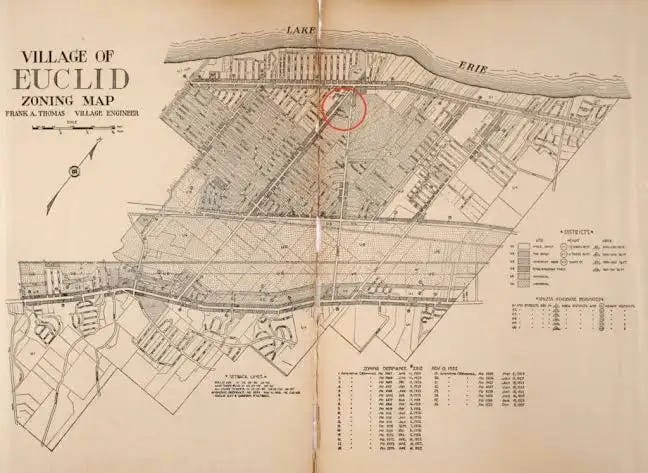
This November marks the centenary of Village of Euclid v. Ambler Realty Co., the Supreme Court decision that gave comprehensive zoning its constitutional footing. At America’s semiquincentennial, it is worth asking what that precedent has meant for the allocation of land, opportunity, and property rights across a nation that otherwise celebrates markets, mobility, and limited government.
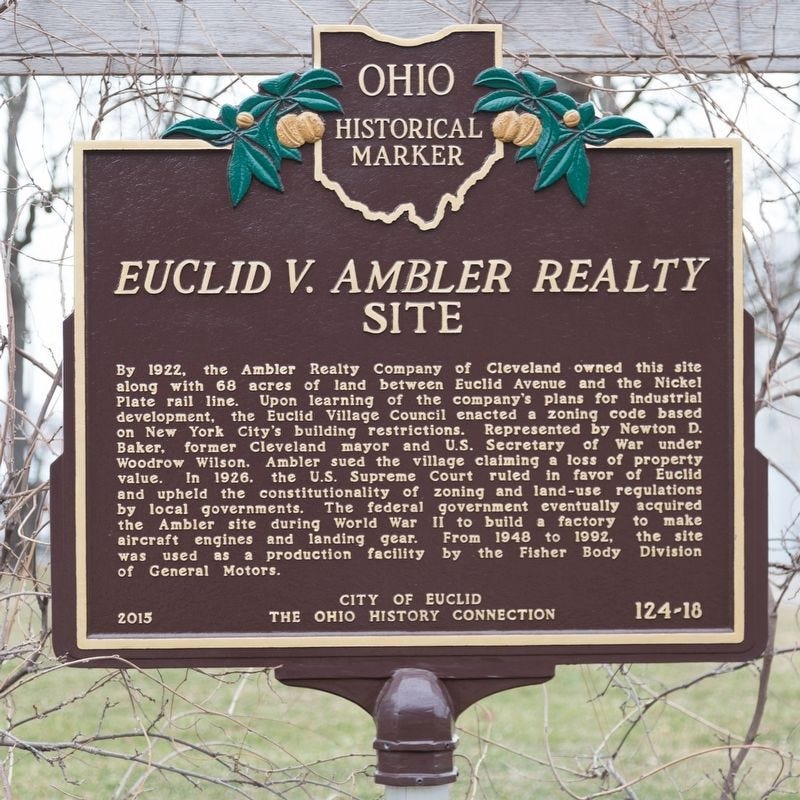
In 1922, the village of Euclid, Ohio, a Cleveland suburb, adopted a comprehensive zoning ordinance that divided land into use, height, and area districts. Ambler Realty owned roughly 68 acres along Euclid Avenue and the Nickel Plate railroad—land that had obvious industrial and commercial potential. The ordinance placed most of it in residential or limited-use categories, sharply reducing its value.
Ambler sued, arguing that the restrictions deprived it of property without due process and amounted to an uncompensated transfer of value from one set of owners to another. A federal district court agreed and struck down the ordinance. The Supreme Court reversed it in a 6-3 decision on November 22, 1926, establishing the validity of modern zoning.
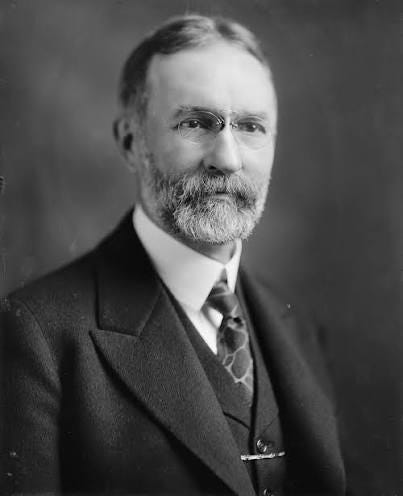
Justice George Sutherland, writing for the majority, held that zoning was a valid exercise of the police power so long as it was not arbitrary or unreasonable. Courts, he wrote, should defer when the validity of a legislative classification was “fairly debatable.” “Apartments”, he added, were “a mere parasite constructed in order to take advantage of…the residential character of the district.", codifying a rationale—still used today—that U.S. courts consider affordable multifamily housing as a pollution. Three justices dissented without filing an opinion.
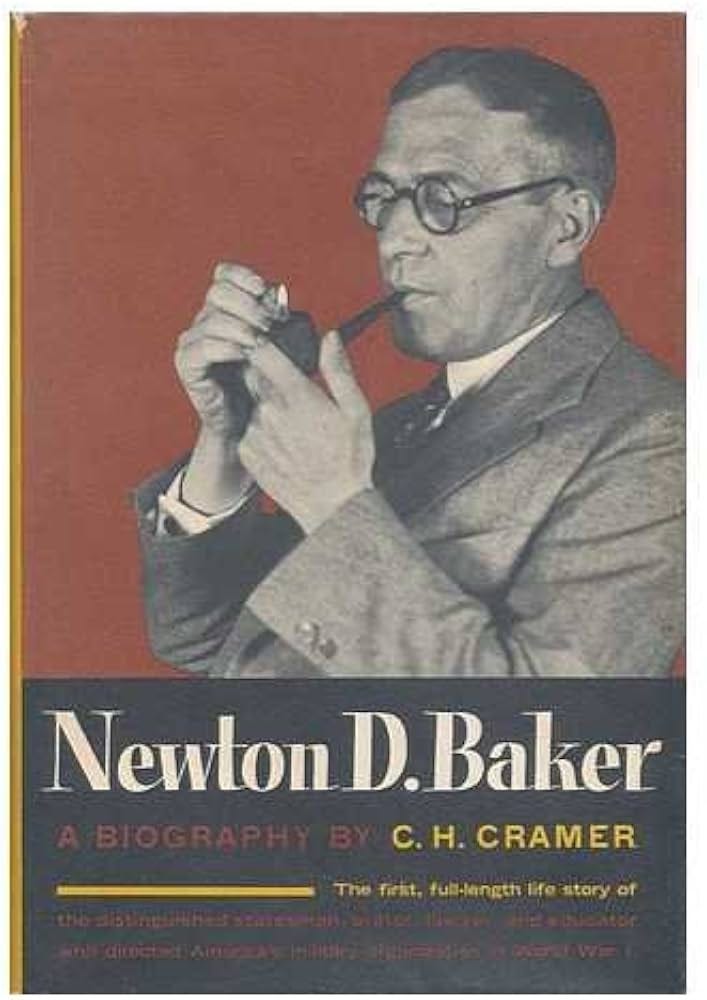
The lawyer who argued Ambler’s case was Newton D. Baker, a former Secretary of War, Cleveland mayor, and formidable orator. Baker’s objections went well beyond the particulars of one suburb’s map. He had a short fuse for the religious and ethnic intolerance that discretionary land-use power, he believed, inherently invited.
…we have outgrown the civilization established by the Constitution and have surrendered private ownership of property into a sort of communistic ownership and control.”
In an unrelated Ohio matter of the same era, he had represented the well-regarded Jewish Orphan Asylum (today Bellefaire JCB) that owned a 20-acre tract and proposed to build a modern cottage-system children’s home. A local “zoning committee” rejected the plan because, in Baker’s paraphrase, “they did not think it would be good for the village to have a large number of Jewish children in it.” Baker warned that this was precisely the misconduct to be expected once municipal authorities enjoyed “a free hand to indulge their prejudices and preferences.”

His broader critique of zoning theory, documented in Michael Allan Wolf’s book above, was still more fundamental. He argued that centralized planning was premised on a grandiose dream of the cunning who were promising powers that they did not have;
“The more experience I have with zoning ordinances, the more satisfied I am that the whole theory is wrong. Nobody knows enough or can know enough to zone a city. As a matter of fact, cities do not grow and will not grow according to any plan, no matter how wise. Their growth is a necessary resultant of economic forces and economic accidents which nobody can foresee…
Baker argued that centralized control of land use was certain to be so slow as to be non-responsive and incapable of keeping up with the needs ot the private citizenry;
In every instance with which I am acquainted, a zoning ordinance has become out of date within two or three years after its passage…with the result that the normal development of the territory has been artificially interfered with.
…and that the regulatory uncertainty and politicization of land use were going to defeat private ambitions and result in merciless pain.
People who rely upon the apparent stability of conditions established by zoning ordinances find themselves defeated in their expectations and in some of the cases of which I have knowledge the results are cruel.
Mistakes made by a single drugstore owner, Baker uses as a case study, are quickly corrected by the market, but mistakes written into comprehensive ordinances are “far more burdensome and their correction more costly and difficult.” If private property could be subjected to “the unrestrained caprice of Village councils” and courts could do no more than presume legislative soundness, Baker concluded, “then obviously we have outgrown the civilization established by the Constitution and have surrendered private ownership of property into a sort of communistic ownership and control.”
In 1926, Baker described a dystopian future that anyone suffering through a rezoning process today would find all too familiar. This broad-brush approach is common in Supreme Court cases, which are less concerned with winning narrow judgments and more concerned with establishing precedents.
In this spirit, Baker was not merely defending Ambler’s balance sheet. He was sounding the alarm bells against a rising progressive faith in expert administration. The early twentieth-century planning movement drew on the same currents that produced scientific management, public-health campaigns, and, in some quarters, eugenic thinking about improving the human stock through social separation.
Credentialed professionals—planners, sanitarians, and civic commissions—claimed a superior vantage from which to order urban growth. Markets and individual owners, by contrast, were seen as chaotic or myopic. Or “less than.” Baker’s mockery of the notion that “the zoners” could “solve all the problems of society and ultimately produce a better and handsomer or human race” was aimed squarely at all that hubris. Wilsonian Progressivism of the 1910s and 1920s was classicism and elitism dressed in the language of expertise: the belief that trained administrators, insulated from electoral or market discipline, could impose rational order on a society they viewed as prone to disorder when left to the people.
The Court sided with the planners. Sutherland’s deferential standard—“if the validity… be fairly debatable, the legislative judgment must be allowed to control”—became the template for the ensuing century of land-use jurisprudence. Within a few short years, copy-paste boilerplate zoning was ubiquitous across the country. The Euclid precedent underwrote not only a routinization of single-family development but also the sweeping powers exercised by figures such as Robert Moses, whose urban-renewal and highway-planning projects remade New York by clearing “blighted” areas, generally poor and minority neighborhoods. Euclid continues to underwrite contemporary NIMBYism, in which organized homeowners and allied politicians invoke “neighborhood character”, “traffic”, “schools”, or environmental capacity to block multifamily housing, accessory units, and modest urban infill.
While overt racial zoning was struck down early (Buchanan v. Warley, 1917) and private covenants unenforceable after Shelley v. Kraemer (1948), and while the Civil Rights era removed many explicit barriers to housing and opportunity, exclusionary zoning remains a durable mechanism of de jure segregation to this day. It is all rooted in and justified by Euclid.
Euclid strips owners—particularly in or near communities that might otherwise add housing supply—of the right to develop their property in response to demand. Euclid prevents minority and working-class neighborhoods from rebuilding or densifying on their own terms. And by constraining housing supply in places with strong job markets and good schools, Euclid raises the price of entry for lower-income households, disproportionately limiting their access to the best opportunities America has to offer.
The justifications for centralized planning offered today are technocratic rather than explicitly racial or ethnic—“compatibility,” “infrastructure capacity,” “sustainability,” or “preserving community character”—but they often function to protect incumbent property values and social composition. Credentialed planning processes give these outcomes a rationalized sheen that echoes the progressive-era confidence Baker derided.
Euclid turns 100 this November. In the unhappy catalog of Supreme Court decisions that entrenched un-American forms of segregation and exclusion, it belongs with Dred Scott and Plessy v. Ferguson. The former was effectively overturned within seven years; the latter fell after fifty-eight.
Euclid pressed on, soon into its second century. Yet the combination of a worsening housing shortage, stagnant mobility for lower-income Americans, and growing skepticism toward credentialed claims of superior knowledge has produced a widening coalition objecting to the decision. Property-rights advocates, housing reformers, and state legislators are all advocating for a reconsideration of zoning police powers that function as ministerial monopolies to the detriment of the people. Public interest law groups now have Euclid in their crosshairs.
The arc of the moral universe is long, as Martin Luther King Jr. observed, but it bends toward justice. Euclid will reach 100, but there is reason to hope that Euclid’s flawed premise will not reach its bicentennial intact.

Aaron Lubeck is a designer & builder with The Rocket Shop in Durham. He is the author of Green Restorations: Sustainable Building and Historic Homes and a former adjunct at Duke University’s Nicholas School, where he taught sustainable home building. Aaron is a founding faculty member with Incremental Development Alliance and was the original host of The Townbuilder’s Podcast, a curated conversation with top new urbanist developers. He writes about policy reform, urbanism, and incremental development at onHousing.

Southern Urbanism is supported by James Hardie and readers like you.

“Credentialed planning processes give these outcomes a rationalized sheen that echoes the progressive-era confidence Baker derided.” This is the irony, because professional planners don’t appear to claim a “superior vantage,” in the vein of the technocratic justification, when they defer to voters and council members who merely uphold the status quo.
I'd be curious to hear what a post-Euclid world might look like. Sometimes a form-based zoning code is the only thing compelling anyone to consider building differently, and yet that is a fragile and imperfect solution at best. If the goal is to build a more complete, responsive, and traditional urbanism, then there are many other barriers to that end that would remain, even if zoning went away. It's not just a code problem. We've lost an entire culture of building places amongst professionals and society at large. In a post-Euclid world, would we see the culture find other means of imposing the same controls or would we see the flowering of a better urbanism?