

Editor’s note: On November 22, 1926, the Supreme Court decided Village of Euclid v. Ambler Realty Co. and upheld comprehensive zoning. Municipalities were now free to dictate what owners built on their land and, by extension, who could afford to live there. The trial judge saw where this was going. The “result to be accomplished”, he wrote, was “to classify the population and segregate them according to their income or situation in life.” The Supreme Court upheld the ordinance anyway. One hundred years later, it’s impossible to open a corner store in most residential neighborhoods. A property owner can’t build an apartment building on their lot if it’s reserved for single-family houses. In much of America, owning land doesn’t mean you get to decide what to do with it.
Euclid at 100 is a four-part series examining how we got here, the ideas behind the decision, what zoning has cost us, and what American cities might look like without it. At Southern Urbanism, we believe cities are built by free people making decisions about the places they own, the businesses they run, and the communities they belong to. These freedoms are worth restoring.
Village of Euclid v. Ambler Realty Co effectively handed the power to make decisions about what-gets-built-where to zoning boards and the governments which house them. From whom was this power appropriated? Was such an appropriation just? Euclid is a landmark in the perennial American debate—just how much government should we have—that tilted the scales decidedly in favor of “more”.
Subsidiarity is a fundamental principle of social organization that insists matters should always be handled by the most local, competent authority.1 It includes, of necessity, the truth that people, families, and society exist prior to the governments they form to serve them.
Subsidiarity is rooted in the idea that all power and authority are given for the sake of those beneath you. All power is power for the sake of lifting others higher, all authority is for the good of others. This is nowhere more obvious than within the family. Parents have power and authority over their children precisely because they are the people most interested in the child’s welfare. All other authority exists in nested hierarchies that follow the same principle. Problems that cannot be solved within the household go out to the extended family, which may in turn go out to the rest of the town, friends, friends of friends, the church, and the whole fabric of other families sharing life in the same place as you. With each ascending step up the scale, you reach the level of authority who is most properly concerned with the good of those involved. Problems of the highest scale may finally reach a president or a pope.
Critically to our present topic, it does not follow that those at the top of the hierarchy should exercise the same level of authority all the way down. The office of president may be “higher” than that of mine as parent, but it confers no authority whatsoever over my child. The society wide handling of problems and blessings proper to your authority is subsidiarity in action. Subsidiarity is violated when those above overreach into realms below which are not proper to them. But subsidiarity is upheld when the duties of the proper authority are taken by the next highest authority, as in the case of an extended family that takes in an abandoned child. The principle here is the same: matters should always be handled by the most local, competent authority. Incompetent authority is as hateful to subsidiarity as is excessively remote authority. Neither is conducive to expedient, complete, and loving justice.
The question remains: was the federal government the proper authority to pass judgement on the problems presented by Euclid? Is the precedent set by the SCOTUS case one that encouraged, or hindered, subsidiarity?
Ironically, though Euclid the sort of legislation nominally designed to prevent un-wanted industries (like, say, a wartime aircraft plant) from moving into a community, philosophically Euclid is a move towards the imposition of such projects upon unwilling communities (as the later government-forced development of, you guessed it, a wartime aircraft plant on Amber‘s property perfectly demonstrates). That some land use practices are incompatible with one another when placed in close proximity is obvious. That the government should be the de-facto legislator of which uses are deemed compatible is not. But Euclid set a precedent of top-down management that we have wrestled with for a century.
Take just one example from the syllabus of the Euclid court documents:
7. The power to relegate industrial establishments to localities separate from residential sections is not to be denied upon the ground that its exercise will divert a flow of industrial development from the course which it would follow and will thereby injure the complaining land owner. P. 272 U. S. 389.
This claim is interesting, because the government later permitted its violation to a T on the Amber property itself. The essence of Amber’s case is that land was purchased for its potential to be developed commercially/industrially. The village of Euclid created a new zoning map that prohibited such development on the land. Federal government upheld this decision on appeal and penned syllabus note 7 above. The same government suddenly reversed its decision when it entered WWII and promptly allowed the building of an aircraft manufacturing plant, which later became…
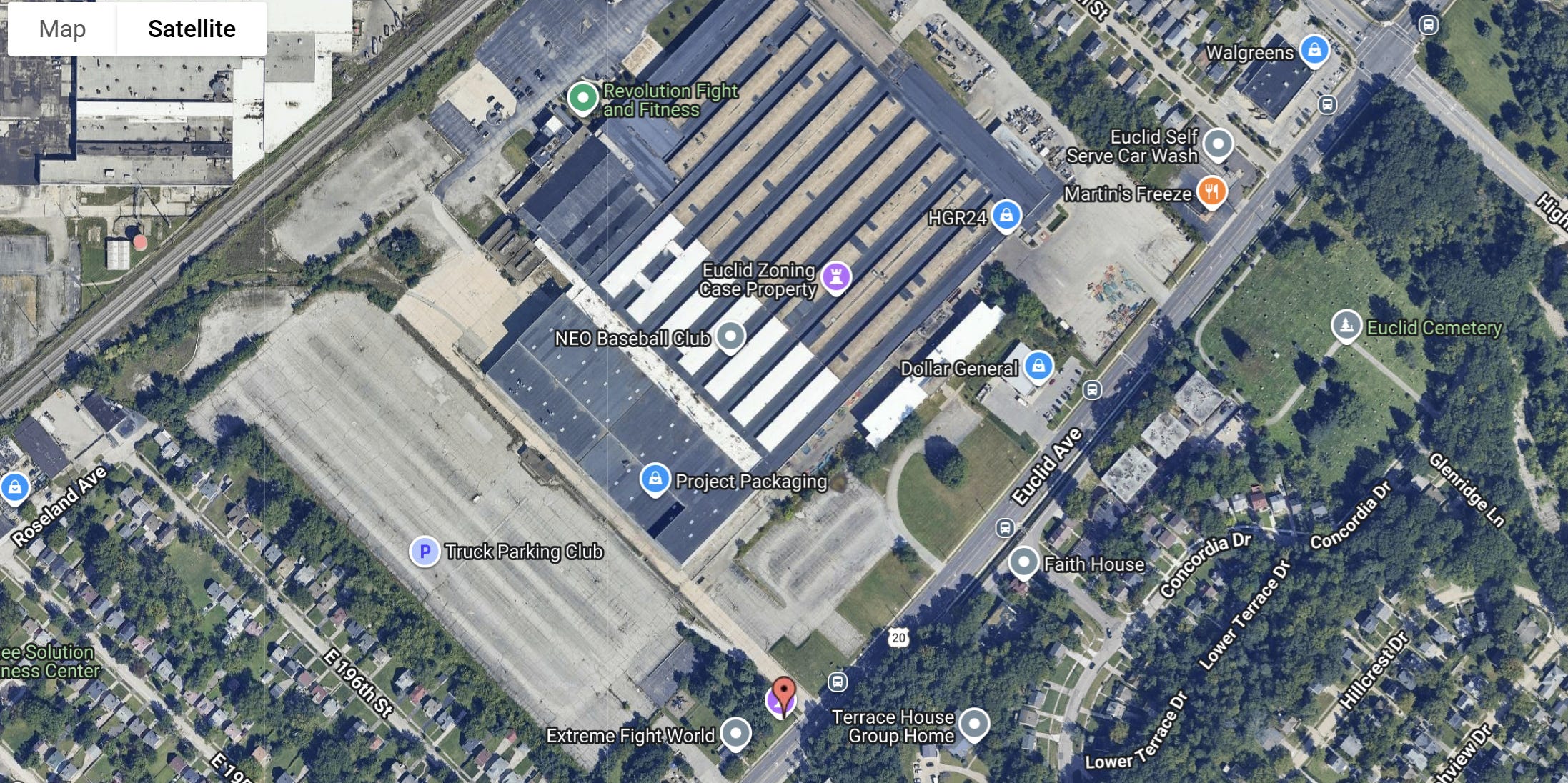
The takeaway here, is that the government overstepped. It was not the right authority to make a land use decision for this community, as evidenced by its later permission of the exact use the original property owner intended. The difficulty exemplified in a case like Euclid is that morality can be very hard to legislate. Beyond the ten commandments, it is fairly difficult to find things that are always and everywhere wrong for everyone. Hence the necessity of wise and virtuous judges, who implement their knowledge of the law to ensure particular justice in the myriad of possible problems that arise in the course of social life.
How else might it be done?
Penny Auctions: a historical counter example
Here are two playbooks. In the first, a big power comes in (like the federal government) and does something everybody recognizes as destructive of their community, say forcing a foreclosure on local farmland. Whatever may have caused the mess, the fundamental things which are not to be disturbed are people and their relationship to the productive property by which they make/earn their living. These are the building blocks of society above which hell may rage but must, on no account whatsoever, be damaged. The whole town knows this, so everyone goes to the auction and bids literal pennies on the foreclosed property. As a deterrent against anyone tempted to sell his soul for his neighbors cheap real estate, a gallows erected outside the auction hall reminded such would-be progressives that the price was 16’ higher than advertised. The auctioneer is forced to take the highest price, which the town ensured was the original property owner, and thus the land was restored to its rightful owner.
The fundamental things which are not to be disturbed are people and their relationship to the productive property by which they make/earn their living.
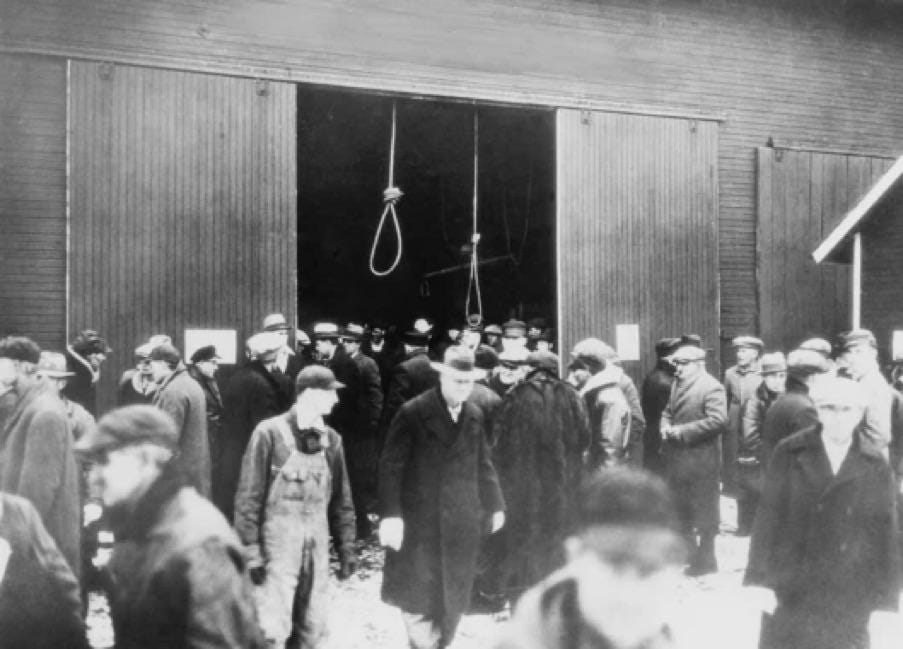
This is a dark example, and it is certainly not a method anyone looks forward to employing. Grim as it may be, it is a justifiable, even laudable, response of the people against a tyranny which threatens their very existence. This is, archetypically at least, an example of subsidiarity: no out-of-town authority is going to come in and kick our neighbors off their land for wrongs they did not commit.
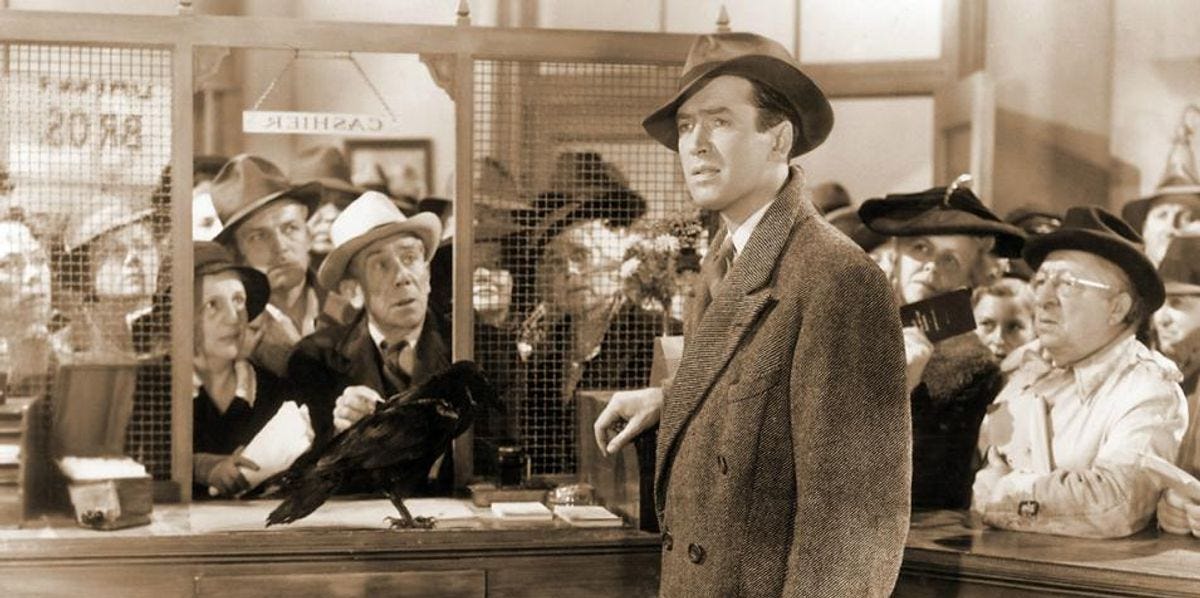
A second, more cheerful example presents itself in the everyman character of George Bailey. Facing a run on the bank, he reminds his friends, family, and neighbors that:
No, but you... you... you’re thinking of this place all wrong. As if I had the money back in a safe. The money’s not here. Your money’s in Joe’s house... (to one of the men)...right next to yours. And in the Kennedy house, and Mrs. Macklin’s house, and a hundred others. Why, you’re lending them the money to build, and then, they’re going to pay it back to you as best they can. Now what are you going to do? Foreclose on them?……..Now, we can get through this thing all right. We’ve got to stick together, though. We’ve got to have faith in each other.
Bedford Falls has a choice: sell each other out for 50 cents on the dollar to the highest power around (Potter), or stand united, shouldering each other’s burdens today so as to rejoice in each other’s joys tomorrow. George’s moving speech presents him as the virtual saint of subsidiarity, using what power and authority he has for the sake of those under his care even at great personal cost. Whatever else is going on in the state, country, and world at the moment, it is George Baily who is the proper authority to respond to the crisis in Bedford Falls. It is unthinkable that he could be replaced by a federal surrogate.
Are we ready to be a post-Euclid people?
The ancient Israelites had no king, they were governed by the guidance of Yahweh as given to them by the prophets. Desirous of appearing like the other nations, they beg Yahweh for a king. Their rulers have become corrupt (taking bribes, insider trading) and for one reason or another they are incapable or unwilling to solve the problem themselves. Yahweh tells them in no uncertain terms what the rule of a king will be like:
“[the king] will take your sons and assign them to his chariots and horses, and they will run before his chariot. He will appoint from among them his commanders of thousands and of hundreds. He will make them do his plowing and harvesting and produce his weapons of war and chariotry. He will use your daughters as perfumers, cooks, and bakers…he will take your male and female servants…he will tithe your flocks…as for you, you will become his slaves…On that day you will cry out because of the king whom you have chosen, but the Lord will not answer you on that day.” - 1 Samuel 8:11-18 (emphasis mine)
Sounds pretty terrible. But the Israelites insist, Yahweh grants them their request, and it goes exactly as he told them it would.
It is worth asking: are we citizens of the 21st century any different? Have we brought Euclid upon ourselves?
Do we not ask of our government and politicians things which we ought rightly to ask of ourselves? We demand that the president “do something” and look with hope to Bernie Sanders when our complaint is with the local police chief who installed flock cameras. We bemoan the loss of the American spirit and condemn the shade-tree mechanic in the same breath. We complain about our neighbors on Nextdoor and slam businesses on Yelp as expressions of our democratic freedom. We take pride in building our own little neighborhood bureaucracies with BOARDS and CAMPAIGNS and ELECTIONS, and isn’t it all so fun? Thank God we have moved beyond neighbors with whom we are friends and whose names are known to us, into the great Enlighted age where the lowest common denominator under which we can “associate” is that of “home owners”.
Are not we all obliged to do unto others as we would have them do to us?
Should it come as any surprise, therefore, that we continue to labor under the yoke of Euclid? What about our conduct as a people demonstrates that we are better than children who must be silenced with “because”? Where else in our lives are we governing ourselves with justice and equanimity? Are we not simply erecting little temples to the spirit of Euclid everywhere we look?
These questions are not meant as brow-beating. There have always been, and God willing always will be, brave men and women who fight the good fight. But the culture wars of the last century, from the counter-culture movements of the 1960s to the cancel culture of the 2010s, have all served to denigrate essential civic qualities; the value of common sense, the supremacy of reason and argument over passions, the necessity of disagreements that are respectful and rooted in rational discourse. The internet has alienated us from one another, our children and grandchildren move away from home. We no longer do anything together that isn’t state sponsored, work related, or otherwise formally programmed.2 Euclid predates all of this, but it is difficult to look at the cultural trends of the last century and conclude that we have moved in the right direction. Where have we shown ourselves desirous, let alone capable, of true self-governance?
We are a people who have perfected the art of cognitive dissonance, quick to detect the sliver in our neighbor’s eye while violently rebuking those who would attend to the beam in our own.

The essays in this series highlight the many problems with Euclid and I will not repeat them here. Suffice it to say that, whatever else Euclid is, it is decidedly not a piece of legislation that well-formed and prospering people would impose upon themselves. It should, naturally enough, be struck down. It’s abolition, however, is only the elimination of an obstacle, it is not the positive creation of some new good thing. Nature abhors a vacuum, and the hole which the disappearance of Euclid will leave in our development landscape will not long remain unfilled. Will we rise to the occasion, and display ourselves the virtues and liberalities we hope to see in others? Will we seek to always do the right and noble thing “at a profit if we can, at a loss if we must”? Will we raise up the George Baileys among us? Or will we sell to Potter for the fastest cash we can and run before new legislation hits?
Euclid has been a net negative for the world. But it is not hard to sympathize with some of the fears at the turn of the 20th century. The evils and excesses of industrialization are well documented if not well known. If Euclid erred in running too far in the opposite direction, the least that can be said is that at least it was running away from a known evil. The pendulum swung so far from the crowded, dirty Dickensian nightmares of the time that we ended up with the sprawling, sterile, suburban nightmares of our time. It is critical that in our push to reverse the damage of Euclid, we strive to do more than simply de-throne an oppressor, we must also install a new ideal, one aligned with the principle of subsidiarity.
A post Euclid world is full of promise and possibility for a revival of subsidiarity, but it will not happen on its own. It need not, I think, cost us any more than a few cents. Perhaps we ought to take it as a warning that penny production has ceased just when we are most in need of reviving the auction which bears its name.
Nick Larkins is a Philosophy-graduate-turned-craftsman. He has worked as a pipe organ builder, welder, historic home GC, timber framer, motorcycle mechanic, and furniture maker. He presently works in Cartersville, GA, as the head of Craeftworks, a millwork and fabrication shop integrating traditional building practices with incremental development. He writes about the interconnection of the building arts, the liberal arts, and human flourishing. He publishes at With Tools in Hand.

Subsidiarity is rooted, and best expressed in, the body of thought and wisdom collectively referred to as Catholic Social Teaching. The encyclicals Rerum Novarum, Quadragesimo Anno, and Centesimus Annus are indispensable reading.
See Robert Putnam’s Bowling Alone for a comprehensive treatment of this alarming trend.