

Editor’s note: On November 22, 1926, the Supreme Court decided Village of Euclid v. Ambler Realty Co. and upheld comprehensive zoning. Municipalities were now free to dictate what owners built on their land and, by extension, who could afford to live there. The trial judge saw where this was going. The “result to be accomplished”, he wrote, was “to classify the population and segregate them according to their income or situation in life.” The Supreme Court upheld the ordinance anyway. One hundred years later, it’s impossible to open a corner store in most residential neighborhoods. A property owner can’t build an apartment building on their lot if it’s reserved for single-family houses. In much of America, owning land doesn’t mean you get to decide what to do with it.
Euclid at 100 is a four-part series examining how we got here, the ideas behind the decision, what zoning has cost us, and what American cities might look like without it. At Southern Urbanism, we believe cities are built by free people making decisions about the places they own, the businesses they run, and the communities they belong to. These freedoms are worth restoring.
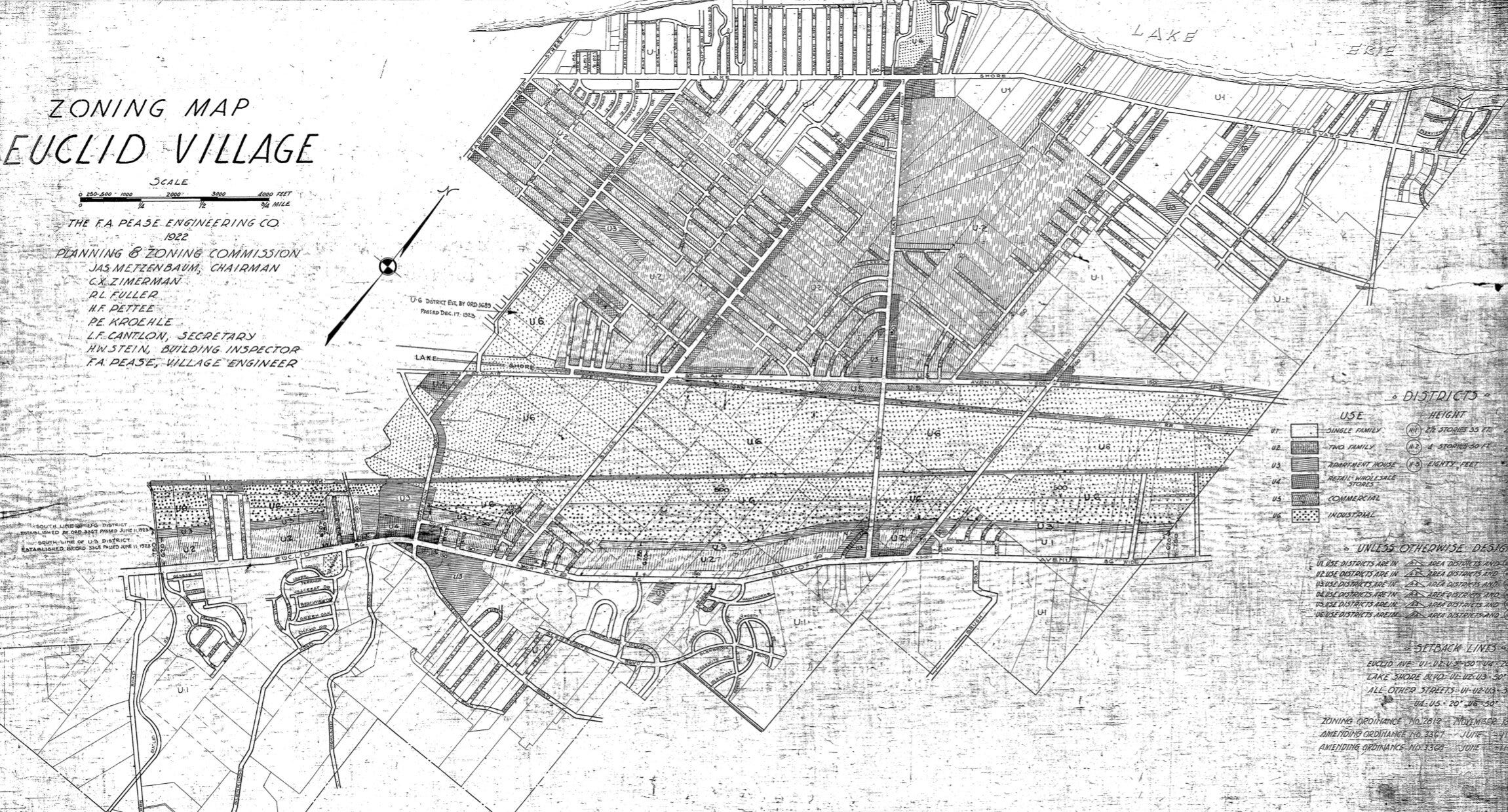
The centennial of the Village of Euclid v. Ambler Realty Co. decision falls on November 22, 2026. On that date, Americans will have endured a century of judicial deference on land-use planning, leaving municipalities with broad authority to sort building uses, heights, and densities under highly subjective standards justified by nebulous rationales of health, safety, morals, and general welfare. Each passing year has justified more power for the state and reserved less for the people, even as some states have begun to curtail local discretion. At 100, it’s time to consider how we might bring all of this to a rightful end.
The powers of cities to codify pseudoscientific parking requirements, demand discretionary review, and preordain land uses without the owner’s consent all emanate from the Euclid decision. The resulting system has produced perpetual housing shortages in high-opportunity places, limited property owners’ ability to respond to demand, and chronic patterns of exclusion.
Euclid’s centennial is a time for reflection. With it, legal institutions and advocacy groups are taking time to understand the decision’s negative impacts and are considering ambitious campaigns to stop these harms from continuing.
In short, that means overturning Euclid.

Supreme Court cases can be overturned. The Supreme Court overturned Plessy v. Ferguson (1896), which upheld racial segregation under the doctrine of “separate but equal,” in Brown v. Board of Education in 1954. Dred Scott v. Sandford (1857), which declared that descendants of enslaved people cannot be citizens of the United States, was overturned by the 14th Amendment of 1868. There are many more. Euclid has not yet followed that path.
From a legal perspective, Euclid will be attacked from multiple angles. Below, I outline three lines of argument that offer the most coherent routes to overturning the decision. Each can be advanced through as-applied challenges, carefully chosen plaintiffs, and supporting amicus work.
1. Euclid Is a (5A) Taking
The strongest vehicle for overturning Euclid is a modern Fifth Amendment Takings Clause claim. Euclid treats severe use restrictions as ordinary police-power regulation rather than a taking of the right to use property. Contemporary doctrine has not fully abandoned that view—cases like Nollan v. California Coastal Commission, Dolan v. City of Tigard, and Cedar Point Nursery v. Hassid have narrowed complete deference for certain sleights (especially exactions) without reaching ordinary use restrictions that leave residual value—but scholarship and lower-court practice have narrowed the gap. Law professors Joshua Braver and Ilya Somin have argued that exclusionary zoning—especially single-family districts that bar apartments, duplexes, or modest commercial uses—should generally be treated as a regulatory taking requiring compensation or invalidation.
The argument rests on the original understanding that the right to use land is part of the property protected by the Fifth Amendment, and on living-constitution theories concerned with oligarchic barriers to mobility. Under anti-oligarchy readings (one interpretive strand, not settled doctrine), such as those by Daron Acemoglu, courts should intervene when ordinary political processes systematically favor incumbents and disadvantage outsiders or diffuse interests (future residents, renters, lower-income workers). Under this view, the complete judicial deference to local zoning decisions (the standard under Euclid) fails to protect the underlying constitutional commitments to equal opportunity and open access.
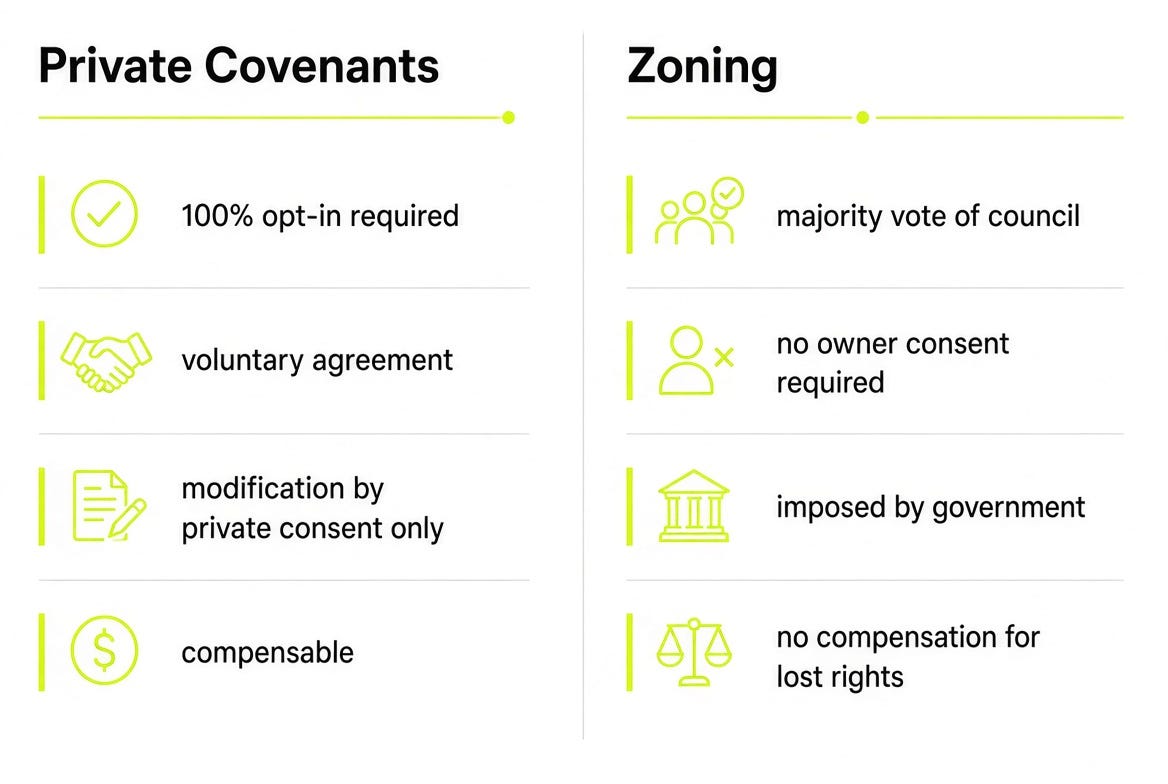
As an example, a clear legal contrast exists between private covenants and zoning. Covenants bind only those who agree to them; they require universal consent among affected owners and can be enforced or modified only by private agreement. Zoning imposes equivalent (often stricter) limits by majority vote of a council or planning commission, requires no consent from the burdened owners, and provides no compensation for the lost development rights.
Given this simplest of simple takings framework, an ideal plaintiff is an owner of residentially zoned land near a job center or transit line who can document a substantial drop in feasible value once apartments or missing-middle housing are barred. The value measurement problem under Penn Central Transportation Co. v. New York City remains real—how much diminution is “too much”—but litigation strategy would pair a takings claim with a request for invalidation or damages, supported by amicus briefs from property-rights organizations and empirical work showing the aggregate productivity loss from Euclid-justified exclusionary rules.
Critically, success would not require the Court to abandon all land-use regulation; it would require compensation or heightened scrutiny once restrictions go beyond traditional nuisance control and destroy a large fraction of the property’s use value. In such a case, Euclid would not be overturned in every application, but it would be substantially gutted for the severe use restrictions that dominate planning practice—effectively the same result for the rules that matter most.
2. Euclid Fails to Deliver Equal Protection Under the Law (14A)
A second path rests on the Equal Protection Clause and the history of discriminatory purpose. Nine years before Euclid, the Supreme Court in Buchanan v. Warley held that an ordinance barring the sale of property across racial lines exceeded the state’s police powers and violated the Fourteenth Amendment’s protection of property and contract rights.

The district court in Ambler warned that upholding the Euclid ordinance would supply a template for achieving similar (racist) ends by proxy. Justice Sutherland’s opinion validated the district court’s concerns, arguing that apartment houses were “mere parasites” (referring generally to recently arrived Italians and Jews) and that separating uses would protect the “residential character” of districts (we can deduce what that means via negativa).
Newton Baker, arguing for Ambler and against the establishment of zoning as precedent, pointed to a recent Ohio case in which a well-managed Jewish orphanage was excluded from a village because local civic authorities did not want “a large number of Jewish children” in their midst. Progressive-era planning literature frequently treated density, immigrants, and the poor as sources of social and biological “pollution.” If Euclid passed, Baker argued, such discriminatory racial policy would take deeper root, especially because it would then be validated (and effectively sanctioned) by the state.
Any 14th Amendment case rests on discriminatory intent, a framework that plaintiffs in Village of Arlington Heights v. Metropolitan Housing Development Corporation failed to prove. The court held that denying multifamily housing was legitimate because no evidence showed that “Discriminatory purpose was a motivating factor in the village’s decision.”
Modern digital records have changed the evidentiary landscape. Well-documented community meetings, neighborhood listservs, Facebook pages, and Nextdoor archives provide discriminatory statements, but courts remain cautious about inferring purpose solely from neighbor hostility; a stronger claim is evidence that public policy decision-makers themselves adopted or ratified the exclusionary rationale. The timing of adoption, linked statements by officials, and the practical effect of barring multifamily housing in previously open areas can all be relevant and revive these older claims.
Many cities’ stormwater exemptions, for example, are applied more leniently to single-family and duplex projects than to multifamily development of comparable or smaller scale. This effectively discourages lower-income housing in a community without saying it out loud. Building-code disparities are easier for municipalities to defend under rational-basis review than pure use restrictions, yet they still illustrate the pattern.
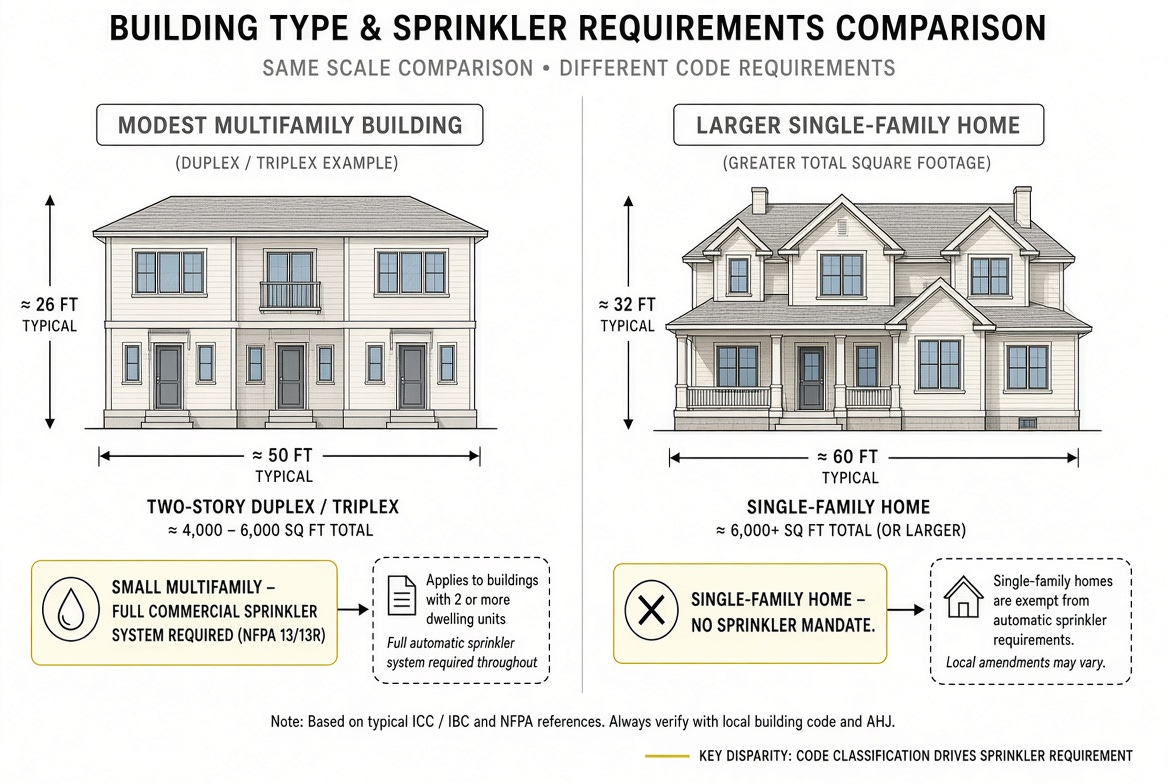
Alli Quinlan, an architect and incremental developer who has documented barriers to missing-middle housing, has highlighted parallel disparities in life-safety rules: multifamily buildings are routinely required to install full sprinkler systems under commercial standards (NFPA 13 or 13R) while single-family homes of similar (and larger) size escape the mandate, even though there is no proof that small multifamily is more of a fire risk.
Public records in multiple jurisdictions show officials specifically seeking to increase the cost of affordable or missing-middle housing to discourage it from being built in their communities.
(As a side note, North Carolina’s House Bill 488 later moved triplexes and quadplexes into the Residential Code and prohibited the Building Code Council from requiring sprinklers for them, precisely because the prior commercial-code treatment had rendered the projects less feasible; in my view, legislative fixes are vastly superior to judicial ones, but this is just where we are.)
An ideal 14th Amendment case would combine historical evidence of discriminatory purpose with modern data showing that rules of this kind continue to raise the cost of smaller multifamily projects relative to single-family construction of equivalent impact. The litigation goal would be a holding that an ostensibly neutral zoning or code was adopted or maintained with discriminatory intent, or that it functions as a proxy for earlier racial and ethnic exclusion, and therefore fails equal-protection obligations under the law.
3. Euclid Fails Its Own “Arbitrary and Capricious” Test
The third line of attack tests the police-power justification on its own terms. Euclid instructed courts to defer when the legislative judgment was “fairly debatable.” But Sutherland, in his majority opinion, also declared that a zoning ordinance violates the Due Process Clause if it is “clearly arbitrary and unreasonable, having no substantial relation to the public health, safety, morals, or the general welfare.” Many current applications clearly fail that test.
Rules that mandate expensive discretionary approvals for established historical forms and uses, or that offer relief from arbitrary requirements unrelated to public health or safety, could only be described as “arbitrary and unreasonable.” Aside from some reasoned environmental concerns worthy of regulation, much of zoning today reflects the utopian, ideological preferences of a profession with little to no experience in the actual practice of citybuilding—preferences that frequently lack a substantial empirical relation to health or safety. Such is the sclerosis caused by 100 years of this flawed decision.
The variance or text-amendment process for a risk-bearing property owner suffering these injuries often provides no practical relief: an applicant must spend significant time and money requesting permission (from non-risk-bearing bureaucrats) to do what the city historically allowed, but the modern ordinance forbids, only to face the same exclusionary participatory political machines that produced the restriction. In practice, the system can be circular—legal only after the applicant pays to make it legal. This asymmetry is ripe for civil-rights litigation. (Many jurisdictions already treat variances as a tool reserved for the extraordinary; the deeper problem is the baseline prohibition plus high standards for relief, which combined justify the litigation.)
What could a case look like? An as-applied challenge focused on a specific ordinance provision with thin empirical support for “health and safety,” brought by an owner who has documented both the cost differential and the absence of a corresponding safety or environmental gain, could force courts to demand more than conjecture. Success would narrow the zone of deference without eliminating the police power altogether—again, gutting Euclid for the rules that matter most without killing every application.
Other Approaches
Other legal theories exist but are less promising. An antitrust claim framing zoning as homeowner regulatory capture faces the obstacle of state-action immunity. Selective-enforcement arguments modeled on Yick Wo v. Hopkins can succeed in particular cases with strong evidence of discriminatory application, but they are difficult to generalize. State constitutional doctrines such as New Jersey’s Mount Laurel fair-share requirement offer useful models for affirmative obligations, yet they do not supply a federal basis for revisiting Euclid. Historical comparisons to Dred Scott and Plessy remain rhetorically powerful as a story of overturning wrongdoing—and can frame amicus briefing—but they are not themselves legal holdings.
A Vision
A practical campaign to overturn Euclid would identify plaintiffs who can document concrete harm—lost development value, differential regulatory cost, or inability to build housing that neighbors of similar scale are permitted to build—and pair them with organizations experienced in property-rights and housing litigation at the highest level of the judicial system. Primarily, the Institute for Justice and Pacific Legal Foundation, both of which appear before the Supreme Court each year and regularly sue governments over land-use wrongs to establish transformative new precedents.
Ideal cases would present clean facts on one of the three theories above, with supporting records on intent or empirical weakness. Amicus briefs could supply the historical materials from the Euclid litigation, modern economic estimates of the cost of exclusion, and comparative evidence from jurisdictions that have already relaxed similar rules. Parallel state legislative campaigns can achieve partial results faster while the federal theories develop.
The objective is not the abolition of all land-use regulation. It is a decision that the severe use restrictions that dominate today either require compensation, rest on demonstrated rather than conjectural connections to health and safety, or cannot be maintained when they continue the exclusionary purposes that Buchanan forbade. Such a result would restore a measure of the property rights and equal-protection principles the 1926 decision set aside, and it would do so in time to prevent the precedent’s second century.

My personal experience is that advocacy that aims to address public-policy wrongdoing occurs in three progressive steps: 1) Show, 2) Shame, 3) Sue.
First, advocates should thoroughly document the wrongdoing and productively propose specific action to correct it.
If that’s ignored, they identify the people blocking the fix, document their behaviors, and share it widely with the world.
And finally, if that doesn’t work, litigate.
Show, Shame, Sue.
After 100 years, it’s time to identify the litigants, and let the lawyers get to work.
Bibliography
Village of Euclid v. Ambler Realty Co., 272 U.S. 365 (1926).
Primary holding and “fairly debatable” / “clearly arbitrary and unreasonable” standard.
Buchanan v. Warley, 245 U.S. 60 (1917).
Pre-Euclid racial zoning decision on property and contract rights.
Village of Arlington Heights v. Metropolitan Housing Development Corp., 429 U.S. 252 (1977).
Discriminatory-intent framework under the Equal Protection Clause.
Braver, Joshua, and Ilya Somin. “The Constitutional Case Against Exclusionary Zoning.” Texas Law Review (forthcoming; SSRN 2024). See also the condensed version in The Atlantic, June 12, 2024.
Originalist and living-constitution arguments treating severe exclusionary use restrictions as regulatory takings; discussion of oligarchic barriers to mobility.
Nollan v. California Coastal Commission, 483 U.S. 825 (1987); Dolan v. City of Tigard, 512 U.S. 374 (1994); Cedar Point Nursery v. Hassid, 594 U.S. 139 (2021).
Essential-nexus, rough-proportionality, and physical-invasion limits on certain regulatory impositions (primarily exactions).
Wolf, Michael Allan. The Zoning of America: Euclid v. Ambler. University Press of Kansas, 2008.
Historical context, Newton Baker’s arguments, Progressive-era planning literature, and the “mere parasites” language and surrounding record.
North Carolina House Bill 488 (2023), Section 9.
Statutory direction moving triplexes and quadplexes into the Residential Code and prohibiting the Building Code Council from requiring automatic fire sprinklers for them.
Quinlan, Alli Thurmond. Public commentary, Incremental Development Alliance materials, and documented local examples of differential code and zoning treatment of missing-middle housing (including life-safety and stormwater rules that raise costs for small multifamily relative to single-family of comparable scale).
Penn Central Transportation Co. v. New York City, 438 U.S. 104 (1978).
Multi-factor regulatory-takings test (economic impact, investment-backed expectations, character of the government action) relevant to measuring diminution in value.
This essay first appeared in “onHousing” at aaronlubeck.com and it’s republished with permission
Aaron Lubeck is a designer & builder with The Rocket Shop in Durham. He is the author of Green Restorations: Sustainable Building and Historic Homes and a former adjunct at Duke University’s Nicholas School, where he taught sustainable home building. Aaron is a founding faculty member with Incremental Development Alliance and was the original host of The Townbuilder’s Podcast, a curated conversation with top new urbanist developers. He writes about policy reform, urbanism, and incremental development at onHousing.

