

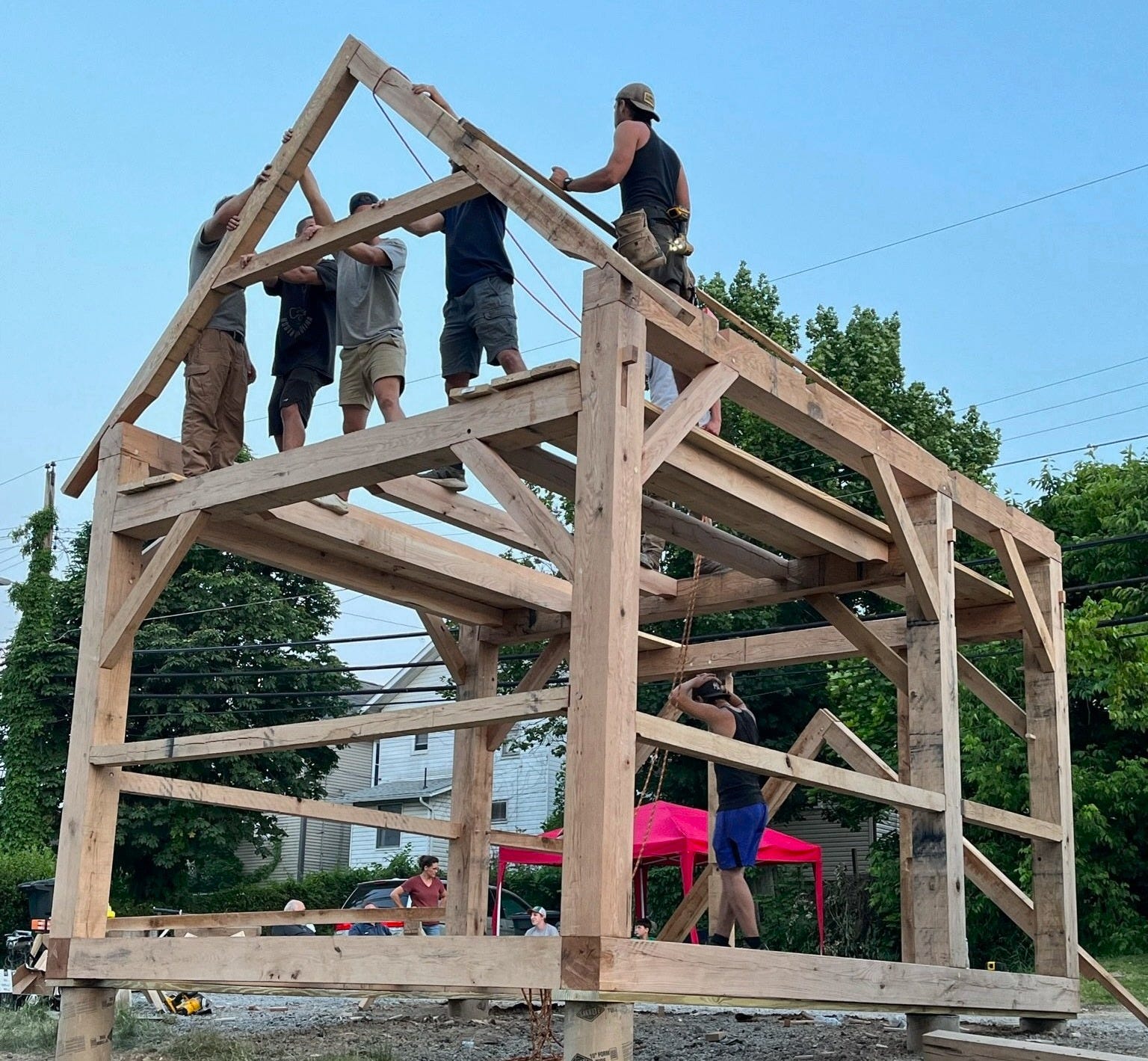
There is a modern view that traditional building methods live on only as the anachronistic preference of the rich. Popular wisdom has it that the amateur builder is limited to Pinterest DIY plans for the “weekend-warrior” and whatever material his local big box construction store happens to stock. But it is not so. The old way of building, and of working, is still possible. This is story of how we pulled off an old-world timber frame raising in a rust belt Ohio backyard, in two weeks, with only a few thousand dollars and 30 pairs of willing, but totally untrained, hands. It is also, more deeply, an exploration of the necessary link between good work and the strong ties of kinship between friends and family.
The Appeal of a Timber Frame
I don’t remember when I first learned what a timber frame was, but I remember when I was struck through the heart with the existential need to build one. I was renting shop space in a shared building, and a copy of Will Beemer’s Learn to Timer Frame appeared one day on the coffee table. I flipped through it apathetically, until I got to a page showing an interior of a completed timber frame and immediately, I understood.
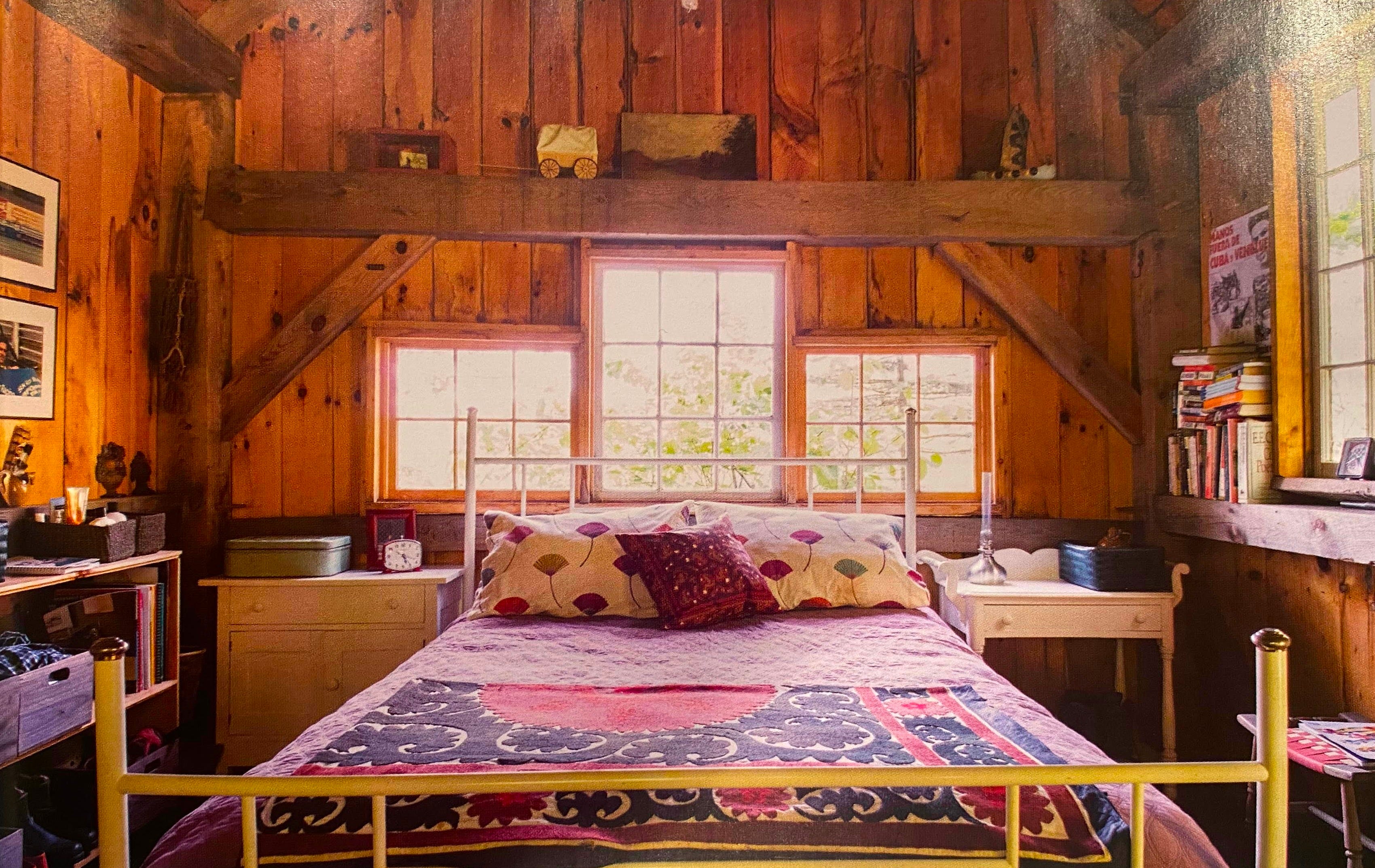
A timber frame is the very character of the home itself, not just the raw material of a house. It is not a substrate to be covered by gypsum board and slathered in “accessible beige” latex paint. It is the harmony of form and function, its strength and its beauty are one and the same. It is the expression of the both the mind and hands of the maker, a visible incarnation of the union of body and soul. It is the elevation of the natural (lumber) into the supernatural (a home) by means of thoughtful human work. Modern building methods tend to efface these marks1, but a timber frame celebrates them. The timber frame is beautiful, durable2, fun to build, and wonderfully fit for the human scale.
Quite naturally then, the desire for a timber frame often conceals a deeper desire for more than just an aesthetic; it conceals a desire for the human conditions that make such a work possible. If nothing else about a timber frame is obvious, it is obvious that it cannot be built alone. I have said the timber frame is fit for the human scale, but it is not fit for the individual working alone. The human condition necessarily includes both family and friends, and it is to the scale of such a community that the timber frame is fit.
Building a timber frame requires a community, and it is this very aspect of necessity which is attractive. The modern built environment is premised upon a total elimination of want and so we have found ourselves in the historical absurdity of a time in which it is not only unlikely, it is unthinkable that the people you live with would help you with the necessities of life. Whatever the real gains of convenience this has occasioned, it is nevertheless an equally real loss that we no longer need our families and friends for anything. For many virtues, and our deepest relationships, are forged only under the conditions of real necessity.
The human condition necessarily includes both family and friends, and it is to the scale of such a community that the timber frame is fit.
Building with Soul
Timber framing is hard work. We often use the phrase “the hard way” to mean a rite of passage we must slog through before we can do things the way they are “really” done. But it has another meaning: things can be hard because they are worth doing. We naturally shrink from things we feel are beneath us, and refuse to engage with them at the cost of demeaning our intelligence or ability. It is the felt sense of meaning and purpose that accompanies the doing of some worthwhile act which draws us to great heights of effort and achievement. This is distinct from saying we should undertake arbitrarily hard things, which is no different from despotism. “Beautiful things are difficult”, says the aphorism, but not all difficult things are beautiful. Timber framing is hard in the former sense: its aims are higher, and therefore its demands are greater, but so are its rewards.
It is the felt sense of meaning and purpose that accompanies the doing of some worthwhile act which draws us to great heights of effort and achievement.
This may explain why more than 30 people accepted my invitation to raising day; an invitation to 12 hours of hard manual labor in the summer sun. A hard sell if ever there was one. That 30 people freely accepted prompts the question: what is the difference between being invited into something, and being imposed upon? You may be happy to help your friend pack a moving van, but you would not do so for 12 hours. Nor would you feel that you were entering into a transcendental activity by doing so. But the farmers of Appalachian—who joined together to clear fields, raise barns, and plant crops for one another—understood that they were doing very much more than “lending a helping hand”. They were building community, practicing virtue, filling the coffers of the commonwealth with mutual goodwill and ties of charity. Its what Wendell Berry is getting at when he talks of the “membership” of Port William. It’s the kind of local social fabric we glimpse in old movies like It’s a Wonderful Life. It is an activity that takes you out of the utilitarian ends of the task at hand and up into something higher: tradition, community, friendship, kinship, etc.
That was what I wanted. I wanted the deep relationships made possible by real work. I wanted a chance to develop the virtues timber framing would require and offer the opportunity for my community to do so with me. It is, on one level, the desire of the gift giver. Love is willing the good of the other. To love your neighbor, your friends, your family, is to want them to be all that they can be. The great delight of community is the chance to love your neighbor in the very same act by which you perfect yourself and the world around you (say, for example, in the building of a timber frame). But the paradox of such goods is that they cannot be “had” except in giving them, and as no one was making any invitations, I decided to do it, and invite everyone else.3
So I called my family, and they all agreed to take off work, travel several states, sleep on floor mats, eat meals in rocking chairs, and work long, hard days to see it through. I scheduled a raising, invited everyone in town I thought would be interested, then buckled down to work of unloading and moving timbers, cutting all the joinery, pouring a foundation, in the hope that come day 14, we would have the frame raised.
The great delight of community is the chance to love your neighbor in the very same act by which you perfect yourself and the world around you
Building the Frame.
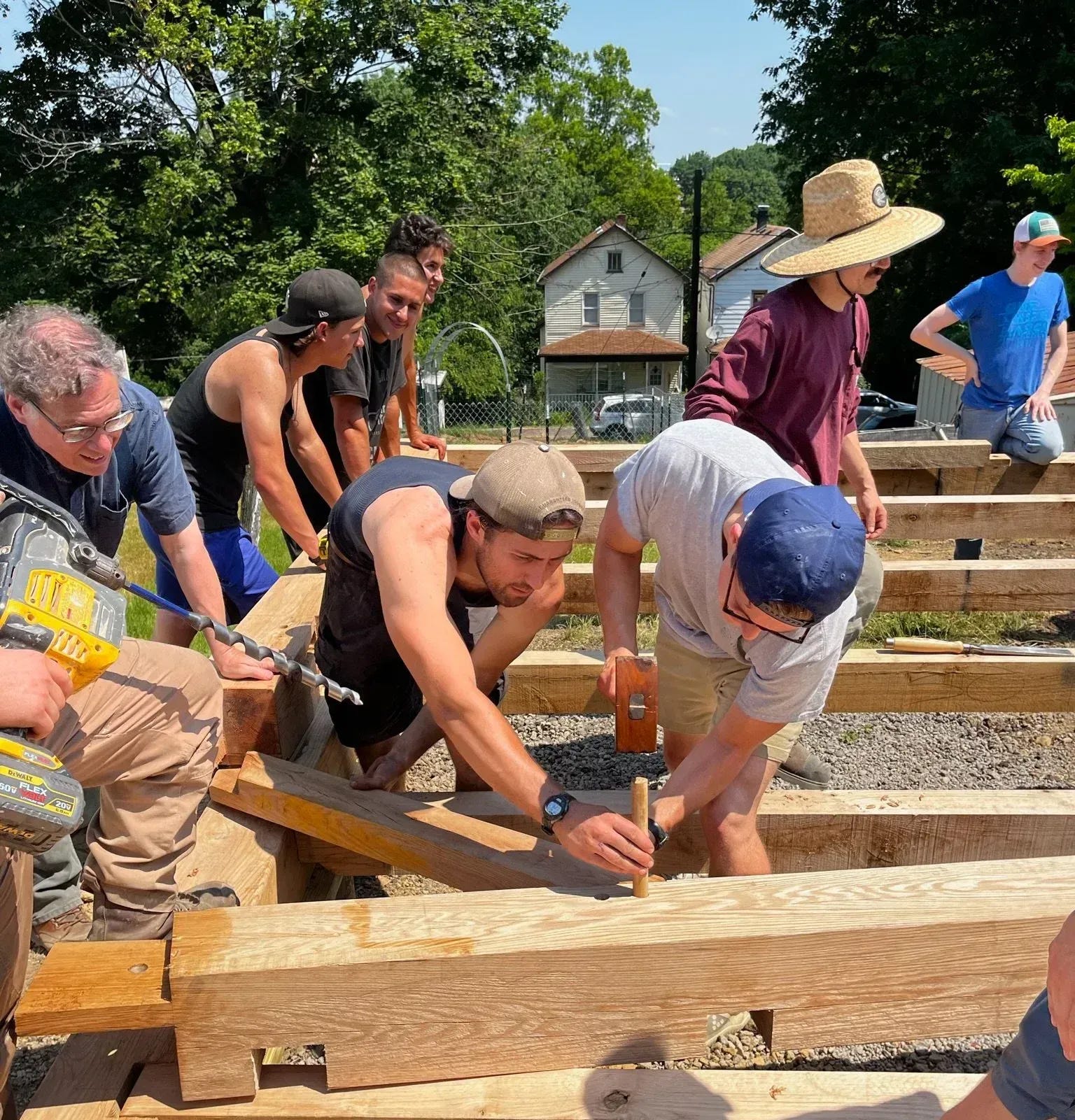
I spent the first week cutting the sills, posts, braces, and tie beams. Braces excepted, these were all 8”x8” green oak parts, It was no small effort to wrestle them into finished timbers working alone. I was sustained in my efforts by kindly friends who would periodically drop by with food (bless you Paul), and to help lift a timber on/off sawhorses. The arrival of my family at the beginning of the second week was an exciting benchmark; I had cut half the frame practically solo, and we now had seven people to finish the second half. True, none of them had so much as built a structure before, much less timber framed one. But they picked it up quickly.
It is a testament to the human scale of the tools and work of timber framing that complete novices can become useful in so short a time. Making pins at a shave horse, riving log blanks, running a mortiser, chopping reductions, spokeshaving rafter swoops, chamfering tenons and handling edges, these are all essential tasks that can be competently performed by anyone who is willing to learn. In one day we cut all the joists and girts. In another, we cut the rafters. In a third, we moved all the wood to my lot and cut both top plates. Over three days, three brothers who had never seen a draw knife split log rounds, rived blanks, and made over 100 pins in their off-time.
To build in this way is to build in a way that invites the involvement of the whole community. The sheer multiplicity of diverse tasks involved in the transformation of raw wood into finished structure means that there is real work for all ages to perform. Timber framing is inclusive, but not in the arbitrary sense of DEI mandates; there is nothing arbitrary in timber framing. The work of timber framing admits of real, meaningful participation across the spectrum of age and ability. Every hand on a heavy lift helps, and there are a hundred small tasks that make up the monumental effort of turning trees into an interlocked structure.


We worked late every night, and were always ready for meals when they came. But there was still time in the day to enjoy a morning coffee or evening beer, and the feeling of growing competence together with our progress made for a highly convivial atmosphere. True, we had the ambitious goal of raising by the end of the week, but within the context of the far more important goal of learning to work well together such that good work was indistinguishable from good fun.4
We had the ambitious goal of raising by the end of the week, but within the context of the far more important goal of learning to work well together such that good work was indistinguishable from good fun.


The reader would be mistaken to believe that the two weeks we spent building were suffused with a constant glow of fraternal charity. We got frustrated, we were short with each other, we fooled around at inopportune moments. Things went wrong. We busted both collar ties during installation. Someone let all the chickens out while we were moving a 500lb beam, helpless to do anything but watch as they disappeared into the neighborhood. All of these were opportunities to let the project spiral into failure. There is no method of building which obviates all difficulty.
But there methods of building which make it more or less worth rising to the occasion. In such moments, one must choose to do the hard, right thing. To remember that chances to get together with your friends and build something cool are unbelievably precious opportunities for partaking of the best this life has to offer. “Crisis” says the adage “does not develop character, crisis reveals character”. And so it is with real, meaningful work. The virtues of your fellow workers are much more apparent when the stakes are real, their gifts and abilities made present when there is actual opportunity for them to be employed. It has been noted by wiser men than I that a chief cause for the modern weaking of social ties is that we no longer need each other for anything. Choosing to jointly aim for some lofty good which can only be achieved by working together is among the finest means available of fighting back.
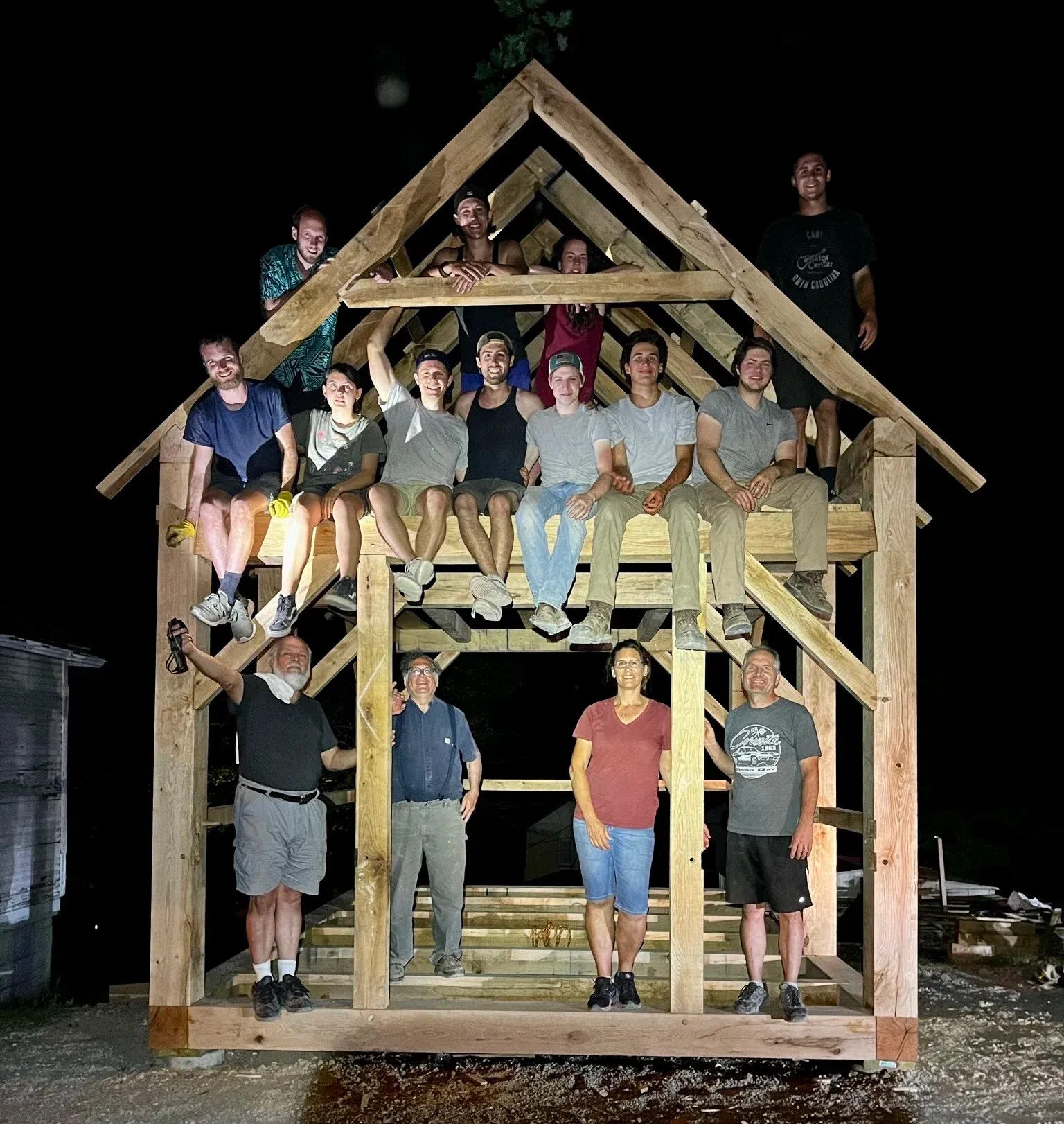
Special thanks to:
Matt, Anita, Greg, Jacob, Vinnie, Becca, & Josh Larkins
John Eagan
Chris Ryland
Paul Denley
Masha Dougherty
Michael Araps
Joshua Feibelman
Josiah Lott
Adam & Dante Robezolli
Dave Matthews
Adam Sandanato
Daniel McNichol
Rey Noll

Quintessential modern minimalism, the architectural equivalent of Keanu Reeve’s life pod in The Matrix.
Timber framing was the only method of wood construction prior to the invention of dimensional lumber in the 1800s. It was synonymous with carpentry. The cathedral roofs of Europe, Norwegian stave churches, half-timbered houses of the French, Swiss, Germans, and English, are all examples of longstanding timber frames. The Barley Barn dates from 1220. See Jack Sobon’s Hand Hewn for a lovely visual guide to timber framing.
The paradox is put simply and powerfully in the prayer of St. Francis: “For it is in giving that we receive, it is in pardoning that we are pardoned, and it is in dying that we are born to eternal life”.
Three years have now passed since the raising. Participants have since told me how fondly they look back on that time, some have said the raising day was one of the coolest things they have ever done. No one has ever told me they look back and wince at the memory of the effort. One of the blessings time pays to the memory of worthwhile labor is an enhanced appreciation for the good and a reduced concern for the effort.
Nick Larkins is a Philosophy-graduate-turned-craftsman, and has worked as a pipe organ builder, welder, historic home GC, timber framer, motorcycle mechanic, and furniture maker. He presently works in Cartersville, GA, as the head of Craeftworks, a millwork and fabrication shop integrating traditional building practices with incremental development. He writes about the interconnection of the building arts, the liberal arts, and human flourishing. He publishes at With Tools in Hand.

This is very cool but I got stuck on a question from the inspo photo -- where does the insulation go? In Ohio you surely need it.
I am glad that you found community, and I agree that heavy timbers are beautiful.
But I think people can also build community while nailing 2x4s or stacking CMUs.