


At 3:11 in the morning on October 20, 2025, a small software update in Northern Virginia made a critical address book entry disappear.
By sunrise, apps and services we use every day across the country began failing. Widely used services like Snapchat, Venmo, Robinhood, Ring, Roblox, Lyft, Starbucks, United Airlines, and the McDonald’s app. went down in unison. Coinbase told customers it could not serve them and that their funds were safe. The Associated Press switched to its backup network. In total, 6.5 million reports came in across more than a thousand services.
Amazon called it an operational issue affecting fourteen services in one of its busiest regions. There was no cyberattack and we were not at war. It was just a corrupted entry that directed computer systems to a building most people drive past without seeing.
Then the systems came back online. People could purchase online again, get coffee, pay friends for last night’s pizza, and book their next trip. The building that makes all of that possible was in the spotlight for a few hours, and then disappeared from view.
“Americans would now rather live next to fission than next to a room full of servers.”
In March 2026, Gallup asked Americans whether they would favor building a data center in their area to support AI. Seventy-one percent said no. Forty-eight percent strongly said no. Only 27 percent were in favor.
For scale, 53 percent oppose a nuclear plant nearby. Americans would now rather live next to fission than next to a room full of servers. Those rooms full of servers, however, already run large parts of daily life. Only about one-third of their electricity currently goes to AI.
The International Energy Agency puts global data center electricity use at roughly 485 terawatt-hours in 2025, about 1.5 percent of world generation. Of that, 155 terawatt-hours ran AI-focused facilities. The other 330 ran everything else: payroll, credit cards, banks, electronic health records, 911 systems, the point-of-sale terminals in grocery stores, DoorDash, and nearly every service that lives on your phone.
When politicians and activists protest data centers, they are often protesting the infrastructure that keeps ordinary life running.
In 1865, William Stanley Jevons published The Coal Question. Buried in it is an observation that still explains how technology and efficiency drive growth. James Watt had made the steam engine dramatically more efficient. Every engine burned less coal per unit of work. British coal consumption climbed steeply anyway.
Cheaper costs and more efficient machines meant more applications, more factories, more engines. It’s almost as if Watt’s small innovation unlocked a massive amount of further growth.
Data centers are like steam engines in 2026. Between 2010 and 2018, the amount of computing work done inside global data centers rose 550 percent. Internet traffic rose more than tenfold. Storage capacity rose by a factor of 25. In stark contrast, energy consumption across those same eight years rose only 6 percent
The industry got so good at its job that it made one of the main costs of digital coordination nearly free. Entrepreneurs around the world quickly found several hundred percent more uses for it.
A marketing problem.
Google published energy figures for its Gemini model in 2025. The median text query drew 0.24 watt-hours, the same as a microwave running for under a second. Independent estimates for a typical ChatGPT query land near 0.3 watt-hours. The average person in the European Union consumes about 17,000 watt-hours of electricity a day.
Individually, the benefit of any single transaction moving through a data center is invisible. Your credit card purchase that clears in a second instead of a minute. The inventory sync that stops a shop from reordering stock it already has on the shelf. The insurance quote that takes a morning instead of a week. Nobody has ever walked out of a store thinking about the settlement layer. Yet all that happens inside data centers.
Aggregate those unnoticeable increments across 340 million Americans and a few hundred million transactions a day, and you get a number large enough to reorganize the entire economy. That is what economies of scale do. The per-unit gain is too small to perceive and the total is too large to ignore.
The problem is that the gains are diffuse but the buildings are big and ugly. The profits concentrate in the firms that mastered the efficiency curve, and politicians capitalize on the resulting inequities. The humming structures appear in places that offer the right grid geometry, fiber routes, and land. And the public, seeing neither the invisible gains nor the broader economic surplus, treats the buildings themselves as the offense.
This asymmetry is the political flashpoint, and it is not unique to servers. It is the same trigger that kills housing when people talk about “developers’ greed.” Concentrated visible cost, even when the cost is mostly perceived rather than measured, beats diffuse invisible benefit at a public hearing every single time.
The building that pays for the schools
Loudoun County, Virginia is the honest test case, because the county publishes its own numbers.
Loudoun has cut its real property tax rate every year for ten consecutive years, from $1.145 per $100 of assessed value in tax year 2016 to $0.805 for tax year 2026. Reach back further and the rate was $1.285 in 2008. Counties do not cut rates for a decade straight while absorbing school growth unless something else is carrying the costs.
By the county’s own accounting, data centers generate almost half of Loudoun’s property tax revenue. Data center property is assessed at $609 per square foot, roughly triple the value of other commercial uses. In 2024 alone the industry added $16 billion to the county’s real property portfolio. And the ratio that ought to stop any downtown director cold: for every $1 in county services a data center consumes, Loudoun collects $26 in tax revenue.
Absent the industry, the county estimates its real property rate would sit above $1.00 instead of $0.805.
In Quincy, Washington, a farming town of 8,500 that once offered little beyond potatoes, apples, and alfalfa, roughly thirty data centers now shoulder an estimated 57 percent of property taxes, as reported by CNN. The result is visible on the ground: a $120 million high school, a new hospital, a public library, police and fire stations, paved sidewalks, a wastewater plant, a $15 million aquatic center with waterslides and a lazy river, and a 143,000-square-foot indoor sports complex on the way. Poverty fell from 29.4 percent in 2012 to 6.2 percent in 2024. New housing was built (which can bring property tax rates and bills down further, in responsible local governments).
As an economic bonus, local hardware, grocery, and other stores stocked up for the construction crews and still thrive from the added economic growth.
The town is still a farming town. Food processors remain the largest employers. Real, on the ground local economies cannot be erased by data centers. A win-win solution is to get the companies behind the facilities to fund public goods that transform a low-opportunity place into a thriving economy.
“By the county’s own accounting, data centers generate almost half of Loudoun’s property tax revenue.”
In June 2026, researchers looked at what actually happened to household electricity rates across the country as data centers grew between 2015 and 2024. They found something most people do not expect: when a state roughly doubled its data center capacity, residential rates fell by about 3.5 percent. Over the more recent period from 2019 to 2024, the average American household lived in a state where data center capacity grew 160 percent. Those households paid roughly 6 percent less than they would have without that growth.
The reason is simple once you see it. The electric grid has enormous fixed costs, i.e. poles, wires, substations, that exist whether anyone is using them or not. Households use electricity in peaks and valleys. Data centers run steadily, around the clock, at very high capacity. When a large, constant user is added to a system that still has room, the fixed costs spread across more total electricity and the average price for everyone falls.
Virginia, which hosts more data centers than any other state, saw rate increases close to the national average. California, which added comparatively few, saw residential prices climb nearly 40 percent driven largely by wildfire costs, not servers.
In the large regional grid serving 67 million people across the mid-Atlantic and Midwest, the price utilities pay to guarantee future power availability has risen sharply. A large share of that increase has been tied to data centers, including facilities not yet built.
Both things can be true at once: average rates for households can fall while the cost of reserving future capacity rises. The difference is how the rules are written.
When a large new user is required to pay for the upgrades it needs, everyone else’s average cost can drop. When regulators let the utility build extra capacity on speculation and spread the bill across every ratepayer, ordinary households end up subsidizing someone else’s option.
There is an even cheaper option sitting in plain sight. Researchers found that the existing grid could handle a large amount of new demand (roughly 10 percent of the national peak) if those big users agreed to briefly reduce their use for the few coldest and hottest days of the year, when overload could be expected.
We are spending tens of billions on new power plants anyway, with capacity set by planners who even five years ago had no idea that in 2026 we would have 155 terawatt-hour added demand. Data centers can stabilize the grid with almost zero impact to usage, but denials of data center applications are celebrated nationwide.
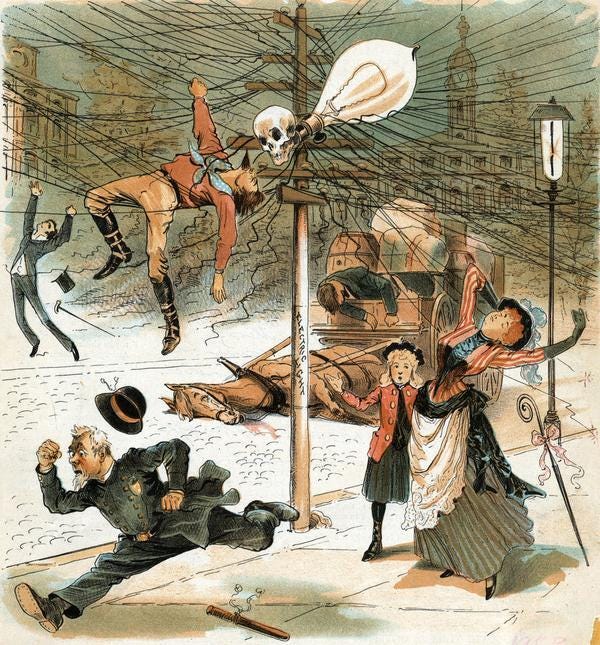
People have always campaigned to stop technology. Doctors warned bodies would disintegrate when traveling at 30 mph on a train, and farmers thought the locomotive would render their cows barren. Electrical grids were portrayed as live wires strangling people. Fears of organ damage from microwave oven use, or 5G as a mind control instrument, have won politicians many an election, with great benefits to their campaign funds, and little achievement in the face of real progress.
These recurring technological panics stem from a fundamental mismatch between rapid innovation and ancient human psychology. Whenever a new technology relies on invisible or poorly understood forces, our brains naturally fill the informational void with worst-case scenarios.
“People have always campaigned to stop technology. Doctors warned bodies would disintegrate when traveling at 30 mph on a train, and farmers thought the locomotive would render their cows barren.”
Human psychology is wired to treat novel, unquantifiable risks as immediate threats. Every major technological leap inevitably triggers the exact same cycle of existential dread, moral outrage, and health scares. The anxiety is tamed when social movements organize around claims that sound good and try to prevent what works. Political victories give people a sense of agency or control over their immediate environment, whenever they get their local council to deny an application to build a new data center.
Technology and innovation, however, do not stop, and then, one day, the unfamiliar finally becomes mundane, and everyone can have cheap electricity, microwave Kung Pao Chicken, and Instagram.
The building is sold by opponents as a cataclysmic event. Reality would like a word.
Off by an order of magnitude
According to Lawrence Berkeley National Laboratory, direct water consumption by every data center in the United States was 66 billion liters in 2023. That is 17.4 billion gallons.
American golf courses applied 1.63 million acre-feet of irrigation water in 2024. That is 531 billion gallons. Roughly thirty times the entire direct draw of the American data center industry.
California’s almond orchards covered 1.39 million bearing acres in 2025. The crop consumes something near five million acre-feet, about 1.6 trillion gallons. Ninety times the data centers. Roughly 70 percent of the harvest is exported.
American households pour close to 8 billion gallons a day onto lawns and landscaping. Every data center in the country uses, directly, about two days of American lawn watering per year.
A family running 300 loads of laundry a year through a standard machine at 20 gallons a load uses 6,000 gallons. The direct water consumption of the entire American data center industry equals the annual laundry of roughly 2.9 million households.
A larger number circulates when indirect water use at power plants is included. Even then the total remains well below golf course irrigation and a fraction of almond production. Siting still matters. A gallon in a water-stressed region is not the same as a gallon elsewhere. That is a planning question, but in no way is it proof that the industry is drinking the country dry.
Every Main Street business thrives on data centers
The card reader on the counter of every single small business on your Main Street clears through one of these buildings. The scheduling app your hair salon runs on lives in one. Your job’s payroll app, the travel app you use to book your next journey, the insurance binder you send to your landlord, your pharmacy’s prescription app, the accounting app you use to do your taxes, the phone system, the security cameras, the Instagram account that fills the tables on Saturday. They all pass through data centers. Any advancement on those and many other aspects of daily life requires a proportional increase in the construction of data centers.
When Amazon’s regional network went dark last October, the mobile order queue at every McDonald’s in America stopped, along with many smaller registers that never made the news.
A district that fights these buildings is fighting its own back office. A district that creates the conditions to host one in a win-win situation gets something no downtown organization or economic development office has ever managed to conjure on its own: a ratepayer that consumes almost no municipal services, sends no children to school, generates little rush-hour traffic, and can fund schools, community centers, and other public goods, as the story from Quincy, WA reminds us.
Of course, not every data center project is good. Location, water sources and usage, rate design, and many other quid pro quos can make a world of difference. A locality that hands out by-right approvals without negotiating these terms has made a bad trade. Loudoun itself closed that door and remains a useful example of course correction.
The current outlook for growth is not great. Seven in ten Americans would rather live beside a nuclear reactor than a building full of hard drives, and half of them say the reason is water and power. The water figure is wrong by roughly an order of magnitude. The power figure, so far, runs the opposite direction from what everybody believes. Yet many political victories are scored using these fears.
The deeper problem is not technical. Visible industrial capacity is treated as a moral failure, and private capital that works at scale is treated as something to be rationed or punished. When the facts on water usage, power generation and electrical rates, and local revenue fail to move the objection, the objection was never about the numbers.
Advanced markets are already solving the hard parts: better siting, water sourcing, interconnection costs, flexible load, co-location with generation. Sensible investors are talking about what benefits can be transferred to local residents, some with tiny marginal costs, that can completely change the development curve of localities up and to the right.
Advanced markets are already working on the hard parts: better siting, water sourcing, interconnection costs, flexible load, and co-location with generation. The useful question is how communities that welcome well-structured projects can capture real local benefits. Rallying opposition is easy. Designing a genuine win-win is harder, and far more valuable.
Rallying up a mob to stop a project is easy, you just have to push on the right buttons. The challenge is to motivate the people who have skin in the game to figure out how to propose a genuine win-win, offer appropriate compensation for towns that welcome data centers, and, for God’s sake, fire their current marketing teams.
That is how you get more of the good kind and fewer of the bad kind, and we get enough supply for the coming demand. We live in exciting times, but few notice the signal among all the noise.
Progress requires capacity. American ingenuity and open markets have a long record of discovering the arrangements that make that capacity possible. Neighborhoods do not need protection from the buildings that can fund their schools and strengthen their commercial districts. They need the clarity to recognize a productive engine when it arrives.
If we let politicians capitalize on fear, the next best solution may be to run data centers orbiting the Earth, where all the profit and direct benefits will go directly to investors. And we will still get our data processed, despite all the opposition.
Jaime Izurieta is an Architect, designer, and urban development consultant, founder of Storefront Mastery. He is the author of Main Street Mavericks and The 10 No-BS Rules For Successful Storefront Design. He has founded a city, a museum, and an architectural practice, planted a few trees, rehabbed a 100-year old farmhouse, co-owned an independent bookseller, worked in the public and private sectors, and taught architectural design studios at university. Jaime writes on Substack at The Vertical Sidewalk.
I agree that we need data centers, and that they can provide a benefit to communities, but it's also very shortsighted for communities to think this is a bailout of an unsustainable suburban development pattern.
Loudoun is the incredibly exclusive and expensive picture of endless sprawl, and data centers are a mere brief bailout to allow them to continue sprawl and exclusivity before the bubble pops. Obviously the data centers won't close up shop anytime soon, but what happens in five or ten years when the chips are out of date? What happens when they're no longer worth what they are today? They'll be forced back into raising property taxes eventually, this just kicks the can down the road.
It's all very reminiscent to me of the factory town that relied on industry until one day it no longer existed. Except in this case they've rolled out the red carpet for the data centers in no time flat while actively campaigning against pro-housing policies here in Virginia.
Great points. The nuclear example is awesome.
Besides the fear of new technology, the larger physical size and impact of the new vs previous use plays a big part in the public reaction.
Then there’s timing, people are wary of large companies over-promising public benefits, with no accountability.
You need leverage to get a win-win. Loudoun County is geographically advantaged location for network interchanges. It’s like comparing the public benefits NYC can leverage during the entitlement process from a big development vs a second tier city or a rural county. All data centers are not the same. AI data centers can jurisdiction shop more than network interchanges or servers.
The other issue is transparency. It’s to the developer’s advantage to minimize public debate. I’d imagine in some industries keeping production water and electrical usage and costs confidential is a competitive advantage. The public should be wary of these costs being externalized on them.
My take is to address it at the state level instead of each city and county dealing it one by one.