

This essay by columnist Nick Larkins will be discussed in our Tuesday, May 5th Happy Hour at 4pm. You can find it right here on Substack, where we’ll be livestreaming!

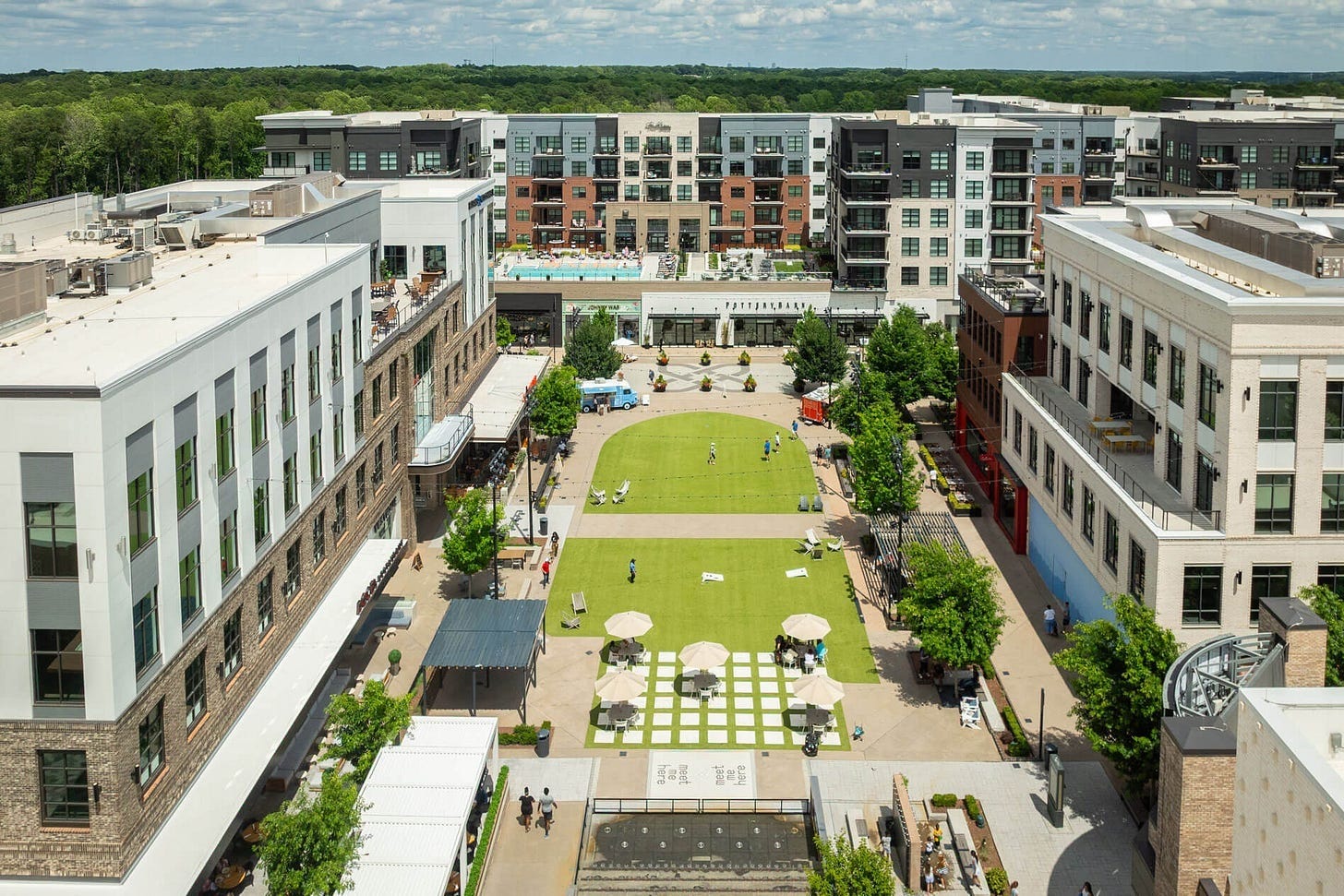
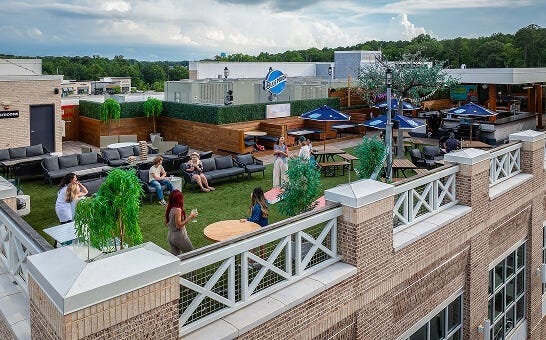
CARY, NC | Recently, I chanced to visit a development characteristic of 21st-century urbanism and growth patterns: Fenton, in Cary, NC. It’s a 92-acre mixed-use residential complex arbitrarily plopped into a forest, one where, ambiguously, “excitement meets possibility” (what one could possibly be excited about while meeting with pure potency is not mentioned). Whatever might have been, nothing is. The meeting went badly. There is nothing exciting about Fenton because, ironically, there is no possibility. There is no possibility because there is no ownership. And where there is no ownership, there is no serendipity: nothing can be other than what is dictated from above. There are no owners, only “residents,” whose personal mark on their surroundings is limited to Command hookable wall decor, and “leasing partners” whose business presence is entirely at the pleasure of the landlord.
You Will Own Nothing and Like it
Fenton is little different than Farmville for real-estate investors. With the right inputs—a little dining here, a wine-tasting night there, a constant stream of entertainment services, and the occasional holiday-themed splurge—Fenton produces (one presumes) a steady ROI and nothing else. (In Farmville’s defense, it produces fictional assets in addition to fictional cash.) None of the things provided are necessarily bad in themselves—though I am strongly inclined to unilaterally condemn “curated igloo experiences”—but one cannot escape the feeling that such things are aping real culture for commercial gain. There is all the difference in the world between a Christmas party hosted by someone, where friends meet with good cheer, and one hosted by something (a corporate entity), where strangers meet for cheap beer. The spiritual hollowness at the core of Fenton is cloaked by the appearance of luxury—everything’s your choice, everything’s convenient. But beneath this veneer, it is nothing more than a company town sustained by the consumerism of its inhabitants. It is the perfect extension of the technocratic mind. We discovered in the last century that “the engine of technological progress work[s] more efficiently when people are conceived of not as children of God or even as citizens but as consumers.”.1 And so every detail of life at Fenton has been carefully structured as an act of consumption. There is no human need left un-commodified: housing, food, clothing, fitness, friendship, even experiences themselves have all been subordinated to an elaborate scheme by which the sole product of the inhabitants (a wage) is siphoned away by any conceivable means to the benefit of the far-distant owners.
The conditions of life at Fenton are thus inimical to community and human flourishing, because they preclude the very conditions necessary for human development: ownership, freedom, and responsibility.
Fenton purports to be a self-contained community; an attempt to leapfrog the messy business of building a town and a community through real life and work by pumping a billion dollars into a few years worth of development. Astroturf meticulously paved over what little grass there might have been passes for a “green space” in cheap imitation of the south’s historic town squares.2 No fewer than eight parking garages service this supposedly “walkable” development, which offers any number of high-end restaurants, shops, and personal services, but no grocer, post office, library, or pharmacy. For such luxuries as these, one must take a car and venture off the reservation. That venerable staple of small-town America, the hardware store, does not exist and never will. What need have Fenton’s residents of hardware, when they do not own anything that could be repaired or improved? Fenton is a microcosm of the modern crisis of identity and community. Bereft of any connection to the past, with no ownership, no thing to call our own, no home repair to help a neighbor with, no serendipitous encounters from a porch with an errand-bound friend, we are left with nothing to do but busy ourselves with the consumption of life’s little pleasures, a need the world (and Fenton) is more than happy to create and fulfill.
Fenton produces nothing, and thus runs afoul of the paradoxical truth that man only finds himself through a sincere gift of himself. You cannot give what you do not have, and the governing principle behind a development like Fenton is that its residents do not strictly speaking “have” anything. The ideal resident at Fenton is a perpetual adolescent: renting a room, leasing a car, eating out when he cannot afford it, financing Door Dash, in a “complicated” relationship. He is not enterprising, he cannot fix his own things, he looks on responsibility as a burden to be avoided. Such a person can hardly be said to be living a full life, and thus has only very little to give to other people in friendship or to communities in service. He is dependent. And while dependency is fully justifiable as a waypoint on the road to independence, it is wholly unacceptable as a perpetual, universal state of being. The conditions of life at Fenton are thus inimical to community and human flourishing, because they preclude the very conditions necessary for human development: ownership, freedom, and responsibility.
What is the alternative?
Common-Sense Community
First, it is worth asking if anything can be held in common when nothing is held in private. What, really, is the difference between Fenton’s “town square” and your apartment? Both are owned by the landlord, and little more than a rental agreement secures the privacy of your room against the publicity of the square. How can the commons exist as something jointly owned by the community if it is merely loaned to them by private interests?
Secondly, the erosion of communal space in our built environment has ramifications beyond the town square. The built environment is the stage on which the drama of human life is played. “A butterfly flaps its wings in the Amazonian jungle,” suggests the proverb, “and subsequently a storm ravages half of Europe.” We may, for all we know, have removed the town square, erased the notion of private property, and adopted the maxim “I shall own nothing and like it,” and inadvertently tripled both the divorce and suicide rate.
Fenton has flattened the human experience of the built environment, once divided into private, public, sacred, and civic, into the homogeneity of the rented. There is a time and a place for renting, but it is dangerous to suggest that ownership should be the default situation for the average citizen. It is even more dangerous to suggest that every aspect of life be re-imagined within the logic of renting. The qualities that define the flourishing person are in many ways linked to ownership. You cannot be courageous with nothing to defend. You cannot be generous with nothing to give. There is no impetus for creativity when you cannot call a thing your own.
And so the antidote to Fenton is the cultivation of ownership. What exists for the common good must really be held in common, what exists for the private citizen must really be held privately. Town squares should belong to their towns, churches to their congregations, businesses to their proprietors, and homes to their occupants. What structures, forms, and policies are most conducive to this is the subject of another essay; for my purpose, it is sufficient to note the principles of a healthy human community. Fenton makes them clear by being structurally opposed to them. We cannot build durable, beautiful, human habitats for people we intend to treat as little more than caged consumers. Fenton is an ecosystem built for the maximization of investor profit, but a town is an ecosystem of human persons working together for their mutual benefit. These two ends are incompatible.
Perhaps we are unwilling to take responsibility for our lives, our homes, our towns. Like any good salesman, Fenton offers what its customers want to buy: community without commitment, place without permanence, purchasing power on a monthly plan. The facade is attractive, but like all deceptions, it is not real and it will not satisfy forever. The best deceptions are those which are mostly true, with a little, fatal lie embedded. The fatal lie at the heart of Fenton is that the good of human community can be had on terms of total dependency. This play has been run before. The American Midwest is riddled with once prosperous small towns sustained entirely by corporate interests (like steel and coal) that were utterly decimated when the companies collapsed. The lesson is that resilience in our built environment is not possible without a diffusion of ownership and productive property.
The difference is that now, 75 years later, our small towns are still worth revitalizing and people are willing to do it. But what will be the fate of Fenton in 75 years, and will anyone want to love it back to life?
1 Neil Postman, Technopoly, ch. 3
2 Contrast the image of fenton above with this beautiful view of Savannah’s Madison square.
Nick Larkins is a Philosophy-graduate-turned-craftsman, and has worked as a pipe organ builder, welder, historic home GC, timber framer, motorcycle mechanic, and furniture maker. He presently works in Cartersville, GA, as the head of Craeftworks, a millwork and fabrication shop integrating traditional building practices with incremental development. He writes about the interconnection of the building arts, the liberal arts, and human flourishing. He publishes at With Tools in Hand.
This is a thought-compelling piece. I certainly share the skepticism of Just-Add-Water (Instant) Urbanism. Even with proper form, the lack of fine-grained ownership should cause us to reject this model as a default just as one might reject the strip malls and subdivisions that this model is purporting to replace in certain communities.
On renting though, I have more mixed feelings. I just purchased my first home, at 35 years old, and as a city planner I have long heard that renters are second-class citizens because they aren't owners. It's that kind of thinking that banishes apartments to big complexes at the edge of stroads, rather than allowing a mix of housing in all neighborhoods. It's that kind of thinking that is used to justify listening to parochial homeowners at the expense of everyone else. It's that kind of thinking that makes people assume that you haven't "arrived" as an adult until you own a detached single-family home, regardless of whether that is a good fit for your life. It's that kind of thinking that makes no room for people to live lifestyles that don't include marriage, kids, and "settling down." This article can be read as a more sophisticated version of those arguments, which I reject as unfair, but I don't know if that was the author's intent.
Does the author intend to critique all renters as a class or is there something specific about the submarket that Fenton is targeted at that is faulty? Is there any difference between the renters at Fenton, the ones in a generic garden apartment complex, and the ones renting in a quad-plex in a traditional neighborhood? Does it mean anything to the writer's argument that even the most pro-social anti-commodity renter will find a scarcity of units that are built with pro-social/neighborhood co-creation embedded in their design? Does Fenton improve upon the garden-apartment complex alternative or does it matter? Is there an appropriate place for the Fentons (or a less commodified version of Fenton) in a community or do we all just need to focus on producing more TNDs and incremental infill?
By the way, I certainly agree with the critique of consumption-oriented life, but I would argue that many homeowners also treat their cities as places to consume rather than places to co-create.
You nailed it. I've never been to Fenton, but I've also been dozens of times as well. And I don't need to go to "this Fenton" to know what I'm not missing.
The New Urbanism model was made real through design and massing, but was all based on the idea of building true community. Using streets to connect, porches to provide opportunities for relationships. Roof top bars are nothing when housing is temporary at best.
Thanks for the insight.