
Written by columnist Jaime Izurieta
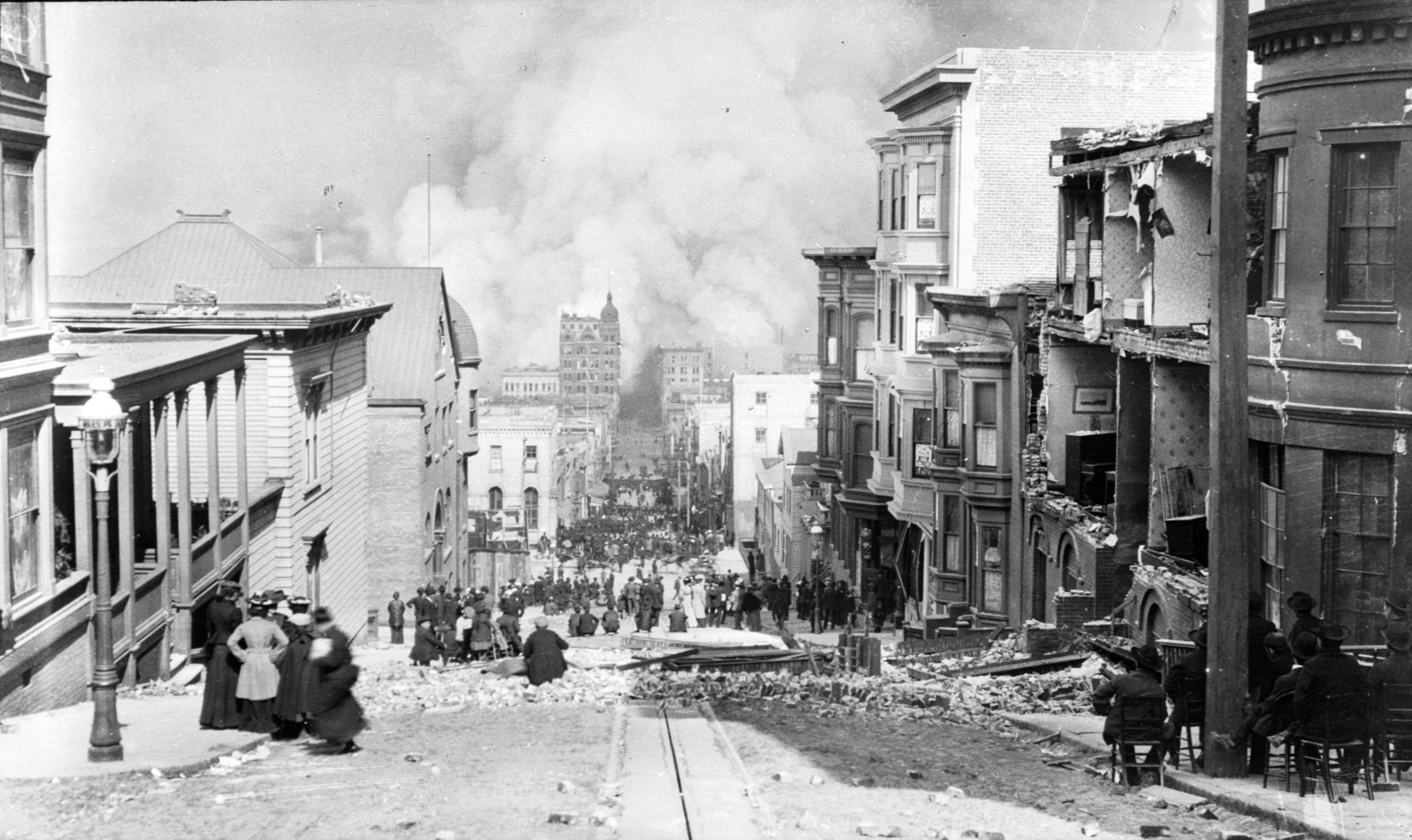
In 1906, San Francisco lost 60% of its housing stock in a single morning. Somehow, there was no ‘housing crisis.’ As embarrassing as it should be to politicians and activists who’ve made fortunes by offering (failed) solutions, a city with 500 leveled blocks functioned better than most modern metros do today, and it’s all happened on their watch.
Before the rubble, there was a system that modern planners would find unrecognizable, if not terrifying. In 1906, San Francisco was the undisputed crown jewel of the West. After the Gold Rush Boom, it was the richest, rowdiest, and most sophisticated city West of Chicago. It built its status in a time when there was no Federal Reserve to manipulate the currency, no federal income tax to fund massive social safety nets, and certainly no Department of Housing and Urban Development to “manage” the recovery.
The earthquake left 250,000 of roughly 400,000 residents homeless and the aftermath saw rents surge 350 percent in days. Yet, there was no “crisis” as we would define today. One May 1906 edition of the Chronicle ran 64 advertisements offering houses or apartments for rent against only four wanted. Without any modern safeguards we now consider immovable, the city was able to house everyone, fully rebuild its housing stock, and recover its population inside three years.
In 1946, Milton Friedman and George Stigler observed this phenomenon in Roofs or Ceilings? written as a critique of the increasingly sclerotic system that cities had been building by imposing “ceilings”, aka price controls, to critical areas of urban progress, such as rents, labor, and education. If the system was already failing 80 years ago, it’s hard to think how much more intricate the structure that supports the failing system has become.
Jane Jacobs documented precisely that escalation in The Death and Life of Great American Cities, showing how the machinery of zoning ordinances, urban-renewal mandates, and planning bureaucracies had already locked neighborhoods into permanent stagnation and stripped away their ability to adapt organically.
Friedman and Stigler’s core thesis in Roofs or Ceilings? was an observation of information theory. They argued that when prices are left to fluctuate freely, they act as a high-speed nervous system for the city.
Let’s remember the context of 1906 San Francisco is a pre-regulatory America. The market didn’t need a committee to tell it that housing was scarce; the price told everyone instantly, and the city’s inhabitants, driven by necessity and the lack of a taxpayer-funded safety net, responded with a level of coordination that no modern bureaucracy has ever replicated. In the ashes of 1906, there was no “Housing Department” to issue vouchers or “Rent Board” to freeze prices. Instead, there was a price signal. When space became scarce, its value skyrocketed.
That spike gave the people an immediate, urgent instruction: Economize. Families squeezed into smaller quarters. People with an extra bedroom suddenly found a reason to open their doors to boarders. Empty summer cottages became primary residences. Within days, the city’s remaining footprint was being used at 100% efficiency. The market “sorted” the population because it was allowed to speak the truth.
The “Compassion” Trap
Fast forward to the modern “progressive” metro. We have the buildings. We have the technology to build fast and safe. We have trillions in tax revenue. What we don’t have is the truth. We’ve replaced the price signal with a bureaucratic filter, and the results are predictably sclerotic.
Jane Jacobs identified that the most dangerous interventions are those that treat symptoms while paralyzing the city’s natural regenerative powers. By ‘fixing’ the price of labor, rent, education, or any other goods, we aren’t helping the poor participate in the city; we are removing the very mechanisms that allow the city to create new work and new niches for them.
Rent Control is sold as a shield for the vulnerable, but in practice, it’s a permanent subsidy for the incumbent, regardless of their wealth. It effectively turns a rental agreement into a quasi-property right. Making leases inheritable and decoupling rent from market value creates a “locked-in” effect that defies all logic of urban efficiency.
It is a system that incentivizes a single person to occupy a four-bedroom, rent-stabilized apartment on the Upper West Side they’ve held since 1975, while a productive family of four is exiled to a crummy second-floor unit in an car-dominant, unwalkable suburb an hour’s commute away. This is an institutionalized misallocation of space. It obliterates the market’s ability to “sort” residents into the units they actually need.
As Jane Jacobs noted in Cities and the Wealth of Nations, a city thrives on the process of replacement. When we freeze the housing market, we stop that replacement. We prevent the young, the ambitious, and the innovators from ever gaining a foothold. The dynamic, breathing ecosystem that solved the obliteration of the inventory in 1906 San Francisco has been replaced with a protected class of incumbents that is guarded by activists and bureaucrats whose entire careers depend on the “housing crisis” never being solved.
Stanford research on San Francisco’s rent control expansion confirms landlords cut rental supply 15 percent, driving citywide rents up 5.1 percent more. In New York City, landlords have taken 26,310 rent-stabilized apartments off the market entirely (vacant and unavailable for rent per the 2023 Housing and Vacancy Survey) while over 100,000 apartments have been lost since 1950 through consolidation of multifamily buildings into larger units or single-family homes.
In contrast, after President Javier Milei repealed Argentina’s rent controls in December 2023, landlords flooded the Buenos Aires market with previously withheld units as rental listings in one digital platform nearly tripled from 5,500 to 15,300, a 180 percent surge, while real rents adjusted for inflation fell 40 percent.
Minimum wages are another “ceiling”, that when divert from actual productivity and are sold like a “living” requirement, forgetting that for many, the first rung of the ladder is higher than their purported output. This means that on top of passing higher costs on to consumers, artificially high minimum wages are pricing a large swath of the labor force out of the market by forcing companies to pay them more than they will produce. This forces the decision of hiring fewer people, increasing responsibilities without extra pay, or simply closing businesses. Studies across decades show a 10 percent minimum wage increase reduces teenage employment by 1 to 2 percent on average, with sharper effects among young people and immigrants.
We’ve manufactured the housing and the homeless crisis at the local level. San Francisco’s 2024 count shows 8,323 people homeless while apartment vacancy sits at 5.1 percent and the city added only 1,597 net units against a state mandate for 82,000 by 2031. Any external factors just make it worse, but local governments and the activists that inform (impose?) policy are 100% on the hook.
The City Eats Itself
The type of “solutions” offered are the very things keeping us trapped. Our regulatory frameworks are an autoimmune disease. We’ve regulated growth and social mobility out of the system. We’re killing the city from within.
In 1906, San Francisco was able to heal itself through the painful, but necessary, feedback of the market. Today, our cities are more like taxidermy: they look like cities from a distance, but they are gradually losing the internal mechanics required to actually breathe, and some are already unrecognizable.
In our obsession to make everything safe and risk-free, we’ve made the stagnation permanent. There is no room to get out because we’ve boarded up the exits in the name of “fairness.”
California has run experiments in many of these areas. It legalized ADUs and duplexes, upzoned statewide multifamily density near transit, passed by-right zoning reforms, and streamlined permitting. Production still misses targets by roughly 100,000 units per year. Median home prices hover near $880,000 and homelessness exceeds 187,000, the worst in the nation. Hundreds of overlapping regulations, redundant jurisdiction through countless agencies, and discretionary vetoes by local supervisors keep every victory irrelevant.
Patches on a dying system leave the regulatory knot intact and solve nothing. The only solution with any teeth is the nuclear one: eliminate rent control completely. Replace all discretionary review with objective by-right rules. Limit the rulebook to fire safety and structural basics. Allow additional units statewide. Restore the price signal as the filter.
The market that rebuilt thousands of units in 500 leveled blocks in three years under 1906 conditions possesses vastly better capital and tools now. Cities that release the chokehold will watch supply surge, costs moderate, and mobility return. Those that keep the filters will remain taxidermy.
The reflection on housing and political controls of urban growth ties to what you’d expect from this Substack because downtown business ecosystems and living commercial districts only revive once cities restore honest economic signals that coordinate housing supply, entrepreneurship, innovation, and street-level energy. Great storefronts are downstream from healthy local economies. It’s our duty to fix those.
Jaime J. Izurieta is a Montclair-based architect and designer, founder of Storefront Mastery, a creative agency that designs downtown experiences, and author of Main Street Mavericks. He works with BID managers, downtown directors, and Main Street leaders to reimagine the streetscape experience.
His work spans partnerships with municipalities, BIDs, UEZs, and downtown organizations across the country, and has been featured on Strong Towns, CNU, and The Sidewalk Ballet podcast. Jaime publishes at Vertical Sidewalk.
Dang! This is good. I'm a casual student of late 18th and 19th Century American history and I'm always amazed at how folks just did stuff. This article should be posted on the doors of Congress and every government body in the land.