
Written by columnist Nick Larkins.
The wistful “they don’t make ’em like they used to”, is an established modern platitude. We may or may not be up to date on the latest development in the Right to Repair movement; we may have only vaguely heard about “planned obsolescence” or the quality of “American steel”—but we know something is different. The sense on the ground, the feeling in the air, the existential certainty that comes after snapping a made-in-China Craftsman socket, is that something has changed for the worse. Whatever the reason, they do not make them like they used to, and no amount of fanfare over the latest tech gizmo is sufficient to unseat this conviction.
There are many proximate causes for this, all reducible to a common denominator: we have lost our heart. The heart which animated great design (from automobiles to architecture) has been ousted in favor of much smaller ambitions: financial and legal at best, malicious at worst. One can build for beauty, for concern that a thing be done as well as it can, for love of the craft, for love of the people who will be affected. Or one can build for shareholder profit, to minimize possible litigation, to express dominance of self-interest over the common good. The things we build are reflections of the things we love. Our built environment, and the things which fill it, are shoddy because as a people, we have largely forgotten our heart.
Much ink has been spilled explaining the diverse ways we have erred.1 But to my mind, the most illuminating of all such explanations is the strange but true circumstance of the American urban landscape, in which it would be illegal to build our most beloved cities and buildings today.
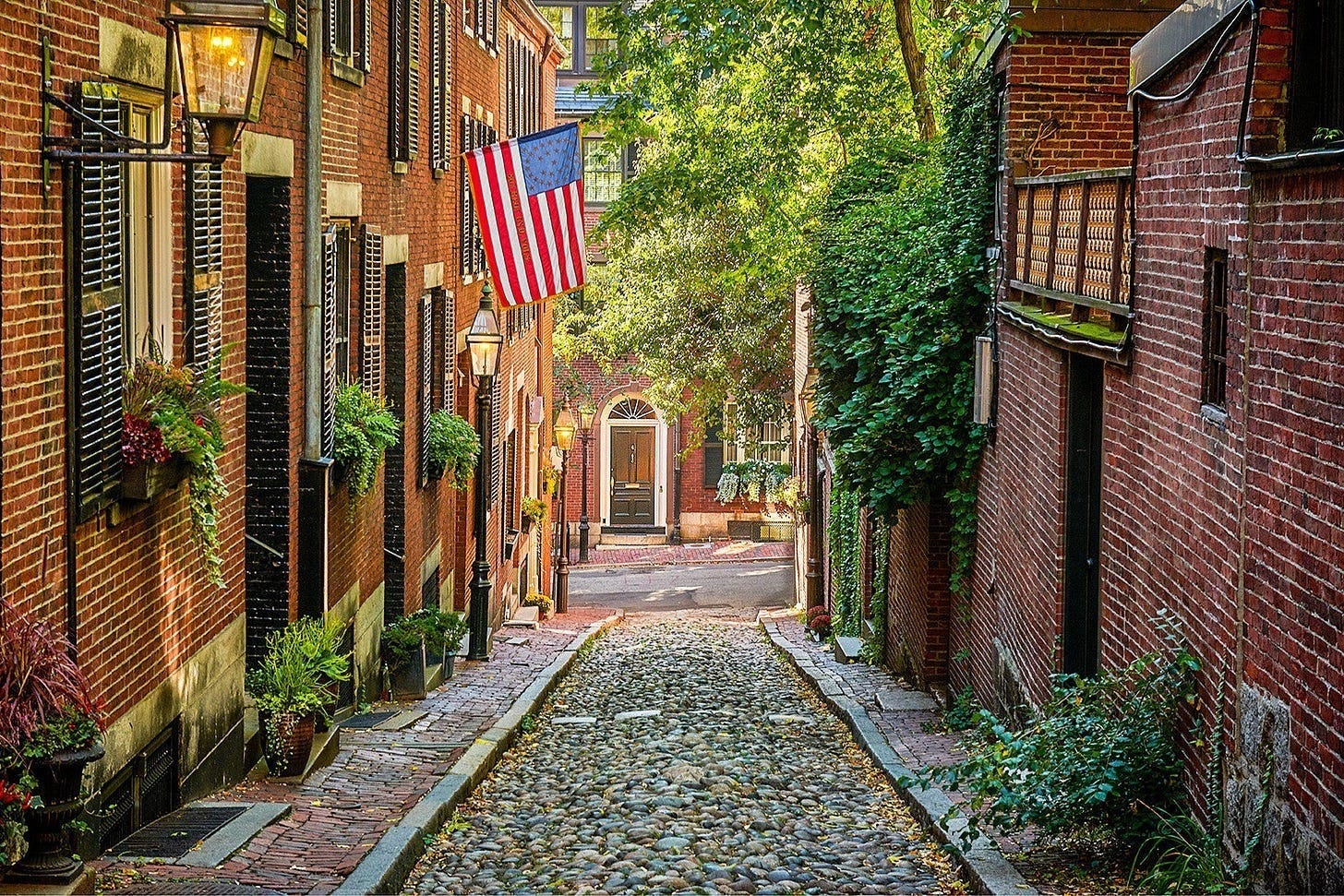
Take but one example: Boston’s Acorn Street. Despite being no more than 200 feet long, and originally the home of the working class rather than the wealthy, Acorn Street is one of Boston’s popular tourist destinations. It is also widely considered to be the most photographed street in America. Yet Acorn Street would be illegal to build almost anywhere in America today.
It is worth asking why it would be illegal to recreate such a popular site. No law was passed against Acorn Street. Citizens did not rally against a common enemy, insisting they no longer wanted any Acorn Streets. Acorn Street was criminalized the way a thousand other such cherished places in America were: one well-intentioned but shortsighted piece of legislation at a time.
The standard reply—that the practical considerations of a more technologically advanced century pushed the Acorn Streets of the world into obsolescence—misses the point. People once built and lived quite happily in the old way, and to judge by Acorn Street’s popularity, many people would still like to build and live that way. We did it. It can be done. Moreover, some major technologies have been adopted without overhauling the entire built environment to fit their needs: the only part of the American landscape affected by indoor plumbing was the outhouse, and indoor plumbing did no harm to the old-world European cities in which it was adopted. The remarkable improvement that indoor plumbing brought to public health and standards of living would have been greatly marred had we legislated the absolute centrality of the bathroom in all homes and cities. One must wonder what our urban landscape might have looked like if the automobile had been integrated as seamlessly.
No, the problem is not one of practicality or of technology. The problem is that we have allowed needs other than the prevailing good of people to be the focus of our design efforts. The solution is to take a holistic view which encompasses the whole person and prioritizes human flourishing. The solution is to put heart back into design. The following philosophy attempts to harmonize these concerns, such that every aspect of building (from design, to construction, to generations worth of cherished use) serve to increase human flourishing.
Beautiful things are made with real materials, by people for whom building is a pleasure, at the human scale, for the benefit of culture across generations.
Beautiful: Beauty is a transcendental quality co-equal with truth and goodness: that which is beautiful is also, by definition, true and good. The goal of design at the highest level is to bring about more truth, beauty, and goodness.
Real: The related qualities of honesty, authenticity, and transparency are best conveyed by materials which are so themselves. Real materials are a wholesome part of a worldview which values beauty, sustainability, locality, and health.
Craftsmen: Similar to Real, it is a contradiction to suggest good design can be accomplished by unseemly means: designs which require work that degrades the value of human life and labor are bad designs. Good design is healthful and pleasurable to labor upon with one’s body and mind.
Human Scale: Because all design, whether civic, domestic, religious, etc., has as its point of reference the human form, good design must encourage, rather than preclude, human engagement. It should draw out the best human qualities: civility, goodwill, reverence, etc.
Generational: Man is not only social, he is historical. His work contributes to the next generation’s heritage because it is impossible to build well without also building durably. Good design respects tradition as proven innovation, and thoughtfully anticipates the needs of the common good from today, to tomorrow, to eternity.
G. K. Chesterton wrote:
But there are some people, nevertheless—and I am one of them—who think that the most practical and important thing about a man is still his view of the universe. We think that for a landlady considering a lodger, it is important to know his income, but still more important to know his philosophy.2
…and he was right. What one thinks of people, what they are for, what is good for them, what happens to them when they die, etc., is far more important than one’s professional qualifications to do a thing. Technical knowledge has no necessary link to a sense of increased moral responsibility; the world is replete with crimes against humanity committed by the credentialed among us. You may be free to believe that “life is but a tale told by an idiot, full of sound and fury, signifying nothing”, that the central question of judgment day will be whether you have “followed the science”, or that the real problem with this world is that there is just not quite enough red tape to go around. But you do not, on such accounts, have any business denying the world its Acorn Streets.
If the things we build are, as I believe, reflections of the things we love, then we will build nothing worth cherishing if we don’t love people and what is good for them. Family. Friendship. Community. Dignified work. Freedom. Justice. Personal ownership. We must put first things first. We must love what is true, good, and beautiful. For goodness is diffusive of itself (it’s easier to make more good stuff if you already have a few good things around), and nothing built according to this philosophy will fail to create more good in the world. Get design really right, and all the rest will follow: craftsmen will be found, people will come, pro-formas will pencil. “Seek ye first the kingdom of God and his righteousness, and all these things will be given to you as well.”3
Nick Larkins is a Philosophy-graduate-turned-craftsman, and has worked as a pipe organ builder, welder, historic home GC, timber framer, motorcycle mechanic, and furniture maker. He presently works in Cartersville, GA, as the head of Craeftworks, a millwork and fabrication shop integrating traditional building practices with incremental development. He writes about the interconnection of the building arts, the liberal arts, and human flourishing. He publishes at With Tools in Hand.
“Suburban Nation” (Andres Duany, Elizabeth Plater-Zyberk, Jeff Speck), “The Color of Law”(Richard Rothstein) to name two histories of the problem which take very different (mutually supporting) angles.
“Heretics” G. K. Chesterton, Introductory remarks pg. 3.
The gospel of St. Matthew 6:33
Lol reminds me of how I used to describe my online rantings: “unhinged ravings of a well-hinged man”.